
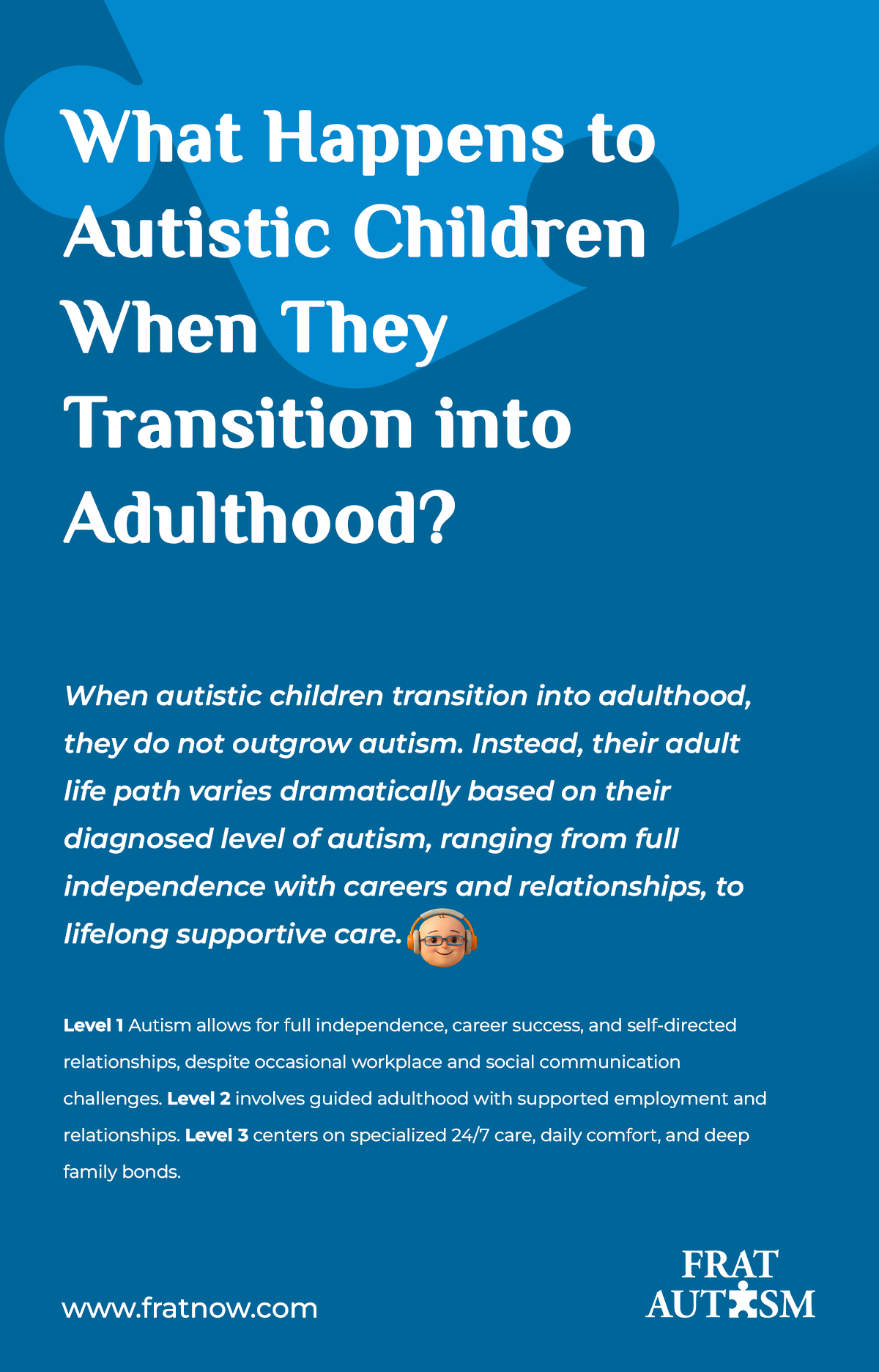
When autistic children transition into adulthood, they do not outgrow autism. Instead, their adult life path varies dramatically based on their diagnosed level of autism, ranging from full independence with careers and relationships, to lifelong supportive care.
Understanding these different trajectories means looking at how your autistic child’s specific level of autism will shape three everyday dimensions of adult life:
- Their career
- Their romantic partnerships
- Their place in the broader community.
Level 1 Autism: Independent & Semi-Independent Adulthood
For parents of a child with Level 1 autism, adulthood offers immense hope. While your child will navigate their own unique set of challenges, this level represents a path where complete independence, career achievement, and rich personal relationships are well within reach.
- Career & Financial Independence:
Possibility: Highly capable of higher education, traditional employment, and financial self-sufficiency, often excelling in detail-oriented or specialized fields.- Example: An autistic adult thriving as a software engineer, accountant, or researcher due to their exceptional focus and deep domain expertise.
Challenge: May struggle with unspoken workplace politics, ambiguous instructions from managers, or the executive function demands of managing multiple projects under tight deadlines.
- Example: Successfully completing a complex technical task easily, but feeling overwhelmed during an unstructured brainstorming session or struggling to navigate unwritten rules about how to pitch an idea to management.
- Personal Relationships (Dating & Marriage):
Possibility: Many form long-term romantic partnerships, marry, and raise families.- Example: Building a stable, loving marriage with a partner who understands their direct communication style and honors their need for quiet downtime.
Challenge: Often struggle to read subtle non-verbal cues or unsaid emotions, requiring partners to state their feelings explicitly.
- Example: If a partner says “I’m fine” while feeling upset, an autistic adult will likely take the words literally and assume nothing is wrong, leading to unintentional miscommunication.
- Social & Community Integration:
Possibility: Fully capable of building deep, meaningful, and long-term friendships with both neurotypical and neurodivergent peers.- Example: Maintaining a close-knit group of friends who value their honesty, loyalty, and unique perspective, whether they are hanging out casually or bonding over common activities.
Challenge: Social exhaustion from the constant mental effort required to navigate fast-paced group conversations or unwritten social dynamics, making large or unstructured gatherings draining over time.
- Example: Deeply enjoying an evening out with close friends, but needing quiet, unstructured downtime the next day to recharge their social energy.
Level 2 Autism: Supported & Guided Childhood
For parents of a child with Level 2 autism, adulthood is defined by structured progress and guided living. While full independence is rarely the outcome, this level represents a path where your child can achieve consistent personal growth, contribute productively, and build meaningful relationships within a supported framework.
- Career & Financial Independence:
Possibility: Capable of steady, routine work in autism-supported workplaces or structured job environments with clear, step-by-step tasks. While they can earn an income, they are rarely fully financially independent and often rely on supplemental government support or family management.- Example: Working successfully in a library, data entry center, or organized retail setting where tasks are predictable and clearly defined.
Challenge: Requires ongoing on-the-job support and struggles when routines break down or unexpected workplace changes occur.
- Example: Excelling at inventory organization when given a visual task list, but needing a job coach or manager to step in and guide them if procedures suddenly change.
- Personal Relationships (Dating & Marriage):
Possibility: Traditional marriage and raising children are extremely rare at Level 2. Possibilities shift toward guided romantic partnerships or supportive companionships—where the couple enjoys each other’s company, affection, and social connection, but relies on a third party (parents, job coaches, or counselors) to manage the logistics, safety, boundaries, and conflict.- Example: Forming a close, affectionate bond with a peer met through a daily community program, where their connection is centered around shared routines, mutual comfort, and social activities.
Challenge: Navigating complex emotional nuances and social conflicts can be challenging. However, it can be managed with the help of constant third-party guidance. This will ensure mutual consent and emotional safety.
- Example: Expressing deep affection and enjoying time together, but relying on a parent or care manager to help structure dates, mediate simple misunderstandings, and uphold personal boundaries.
- Social & Community Integration:
Possibility: Fully capable of active social participation and building friendships, provided these interactions occur within organized community settings, adult day programs, or structured activity groups with predictable routines.- Example: Being an enthusiastic, regular participant in an adaptive sports league, supervised hobby club, or community art workshop where social expectations are gentle and clear.
Challenge: High vulnerability to social isolation, manipulation, or exploitation due to taking statements literally and trusting others easily, requiring active protective safeguards from family or support teams.
- Example: Wanting to make friends easily, but relying on parents or support workers to monitor online interactions, screen new acquaintances, and manage public outings to keep them safe.
Level 3 Autism: Care-Centered & Assisted Adulthood
For parents of a child with Level 3 autism, adulthood shifts entirely from independence to ensuring quality of life, dignity, and continuous care. Traditional milestones like independent careers, marriage, or raising a family are not part of this path; instead, joy and progress are found in physical comfort, sensory engagement, safety, and deep family connections.
- Career & Financial Independence:
Possibility: Autistic individuals at Level 3 are mostly dependent financially on family support, government benefits, or legal estate planning. Daily routines center around adult day programs – specialized daytime care centers where trained staff guide non-work activities focused on sensory comfort, basic life skills, and physical well-being.- Example: Attending a specialized day center for activities like adaptive gardening, music therapy, or supported walks in local parks, where the goal is emotional well-being and engagement rather than earning a wage.
Challenge: Require constant financial stewardship from parents, legal guardians, or trust administrators.
- Example: Needing continuous 1-on-1 support staff to handle basic daily care and relying entirely on a family-managed budget or special needs trust to pay for housing, medical needs, and daily living expenses.
- Personal Relationships (Dating & Marriage):
Possibility: Traditional dating, romantic partnerships, marriage, and raising a family do not occur at Level 3. Instead, emotional connection centers entirely on deep, expressive bonds of affection and trust with parents, family members, and dedicated long-term caregivers.- Example: Showing profound joy and comfort through non-verbal cues—such as smiles, eye contact, relaxed body language, or physical touch—when interacting with familiar, loving family members or caregivers.
Challenge: Complete inability to independently initiate, seek out, or manage personal relationships outside their immediate home or care circle, leaving them entirely reliant on others to build a safe, nurturing environment.
- Example: Feeling content within a familiar setting, but needing family and caregivers to continuously anticipate, interpret, and meet their physical and emotional needs.
- Social & Community Integration:
Possibility: Broad, independent community socializing or building casual peer friendships does not occur at Level 3. Instead, integration centers on living safely and comfortably within specialized residential group homes (community-based houses where trained staff provide round-the-clock care) or family-managed homes tailored around predictable routines and low-sensory environments.- Example: Living comfortably in a dedicated residential care setting, enjoying calm, structured routines like listening to music, watching a favorite show, or going on guided outdoor walks with trained caregivers.
Challenge: Extreme vulnerability to social isolation due to severe communication barriers, making it impossible to independently seek out friendships, express social preferences, or participate in the surrounding community.
- Example: Wanting human connection or feeling lonely, but being unable to communicate that need verbally or socially, relying entirely on caregivers to notice subtle behavioral cues and gently initiate social interaction.
Managing Cerebral Folate Deficiency (CFD)
Cerebral Folate Deficiency (CFD) is a neurological condition where folate (vitamin B9) cannot properly cross the blood-brain barrier to reach the central nervous system. In autistic children, undetected CFD can impair brain metabolism, leading to speech delays, motor difficulties, and cognitive or functional regression.
The FRAT® (Folate Receptor Autoantibody Test) provides a crucial diagnostic solution. By screening for both blocking and binding autoantibodies that interfere with folate transport, FRAT® detects the biological root of brain folate starvation. Identifying these autoantibodies early allows clinicians to prescribe targeted therapies that can help improve long-term cognitive and behavioral outcomes.
Curious to know if your child has these autoantibodies?
Here’s what you can do:
Is a Biological Roadblock Holding Back Your Child's Progress?
Don't just manage behaviors - address the underlying brain chemistry.
Identifying Folate Receptor Autoantibodies is the first step towards a more targeted autism care plan.
To request a FRAT® test kit, click the button below.