
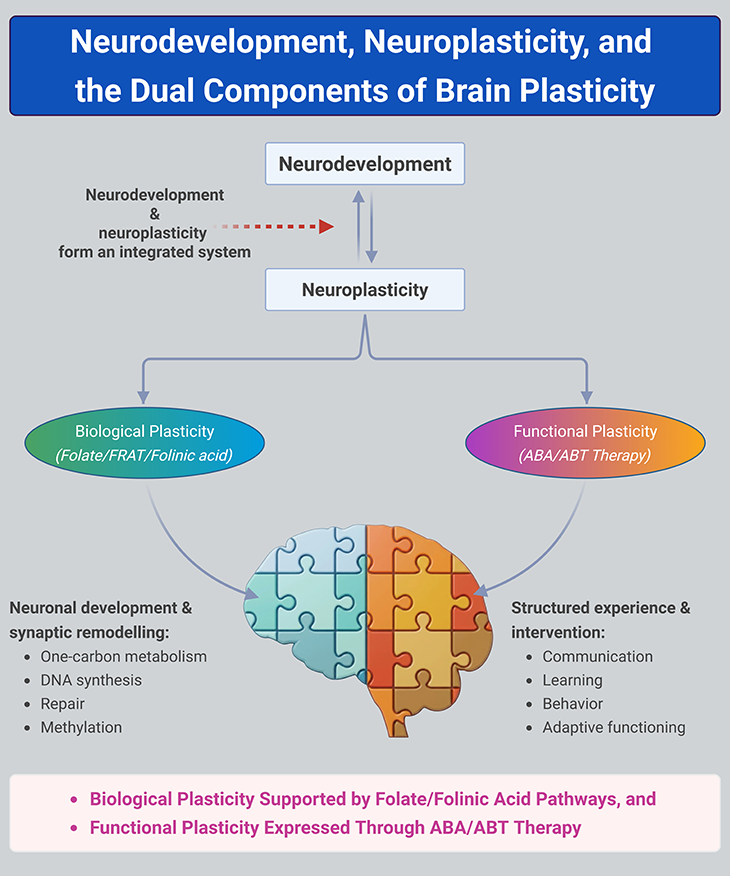
Figure 1. How a Child’s Brain Grows and Learns: Two Pathways Working Together. This figure shows how a child’s brain changes over time through two connected pathways. (1) The first pathway, biological plasticity, reflects the brain’s natural ability to build and strengthen its cells and connections. When the brain’s internal systems are well supported, children have a stronger foundation for learning, communication, and behavior. (2) The second pathway, functional plasticity, represents the improvements that come from guided practice. Structured therapies — such as ABA or ABT — help children learn new skills by repeatedly activating and refining the brain circuits involved in communication, social interaction, and daily functioning. Together, these pathways explain why children benefit most when both their biological needs and their learning needs are supported. A ready brain and consistent practice work side by side, helping each child move toward meaningful developmental progress.
Neurodevelopment, Neuroplasticity, and the Dual Components of Brain Plasticity
Neurodevelopment refers to the growth, organization, and maturation of the nervous system, beginning in prenatal life and continuing through early childhood. During these sensitive periods, the brain establishes its structural architecture, forms foundational circuits, and sets the trajectory for later cognitive, behavioral, and adaptive capacities. This developmental process is deeply influenced by genetic factors, environmental inputs, and metabolic conditions [1-2].
Neuroplasticity—the brain’s ability to modify its connections and reorganize its networks—operates within and beyond these developmental windows. It enables learning, memory formation, and adaptive change across the lifespan. While neurodevelopment lays down the initial blueprint, neuroplasticity allows that blueprint to be refined, strengthened, or compensated through experience and intervention [1-2].
To help audiences understand this relationship clearly, brain plasticity can be conceptualized as having two complementary components:
1. Biological Plasticity
This refers to the cellular and molecular processes that enable the brain to grow, repair, and reorganize. Folate biology—including folate itself, folate receptor autoantibody–mediated deficiency (FRAT), and folinic acid—plays a central role in this domain. Folate-dependent pathways support one-carbon metabolism, DNA synthesis, repair, and methylation, all of which are essential for neuronal development and synaptic remodeling. When folate transport is impaired, as in FRAT, the developing brain may not receive adequate folate during critical periods. Folinic acid, capable of bypassing receptor-mediated transport, can help restore these pathways and support the biological conditions necessary for healthy neurodevelopment and ongoing plasticity [3-5].
2. Functional Plasticity
This refers to the observable changes in communication, learning, behavior, and adaptive functioning that arise from structured experience. Interventions such as Applied Behavior Analysis (ABA/ABT therapy) rely on functional plasticity: they strengthen or reorganize neural circuits through repetition, reinforcement, and guided learning. These therapies do not replace biological supports; rather, they operate on the functional expression of the brain’s capacity to change [1-2].
Understanding these two components clarifies the role of folate-related interventions. Folate biology does not treat autism itself. Autism is a multifactorial condition with numerous biological and environmental contributors. Instead, folate and folinic acid address one specific biological piece of a much larger developmental puzzle. By supporting biological plasticity, they may enhance the brain’s readiness to benefit from functional interventions such as ABA/ABT therapy (see Figure 1) [3-5].
Together, these insights reinforce a central principle: neurodevelopment and neuroplasticity form an integrated system, and folate-related biology provides one essential—though not singular—supporting element within that system. Addressing this biological component can help optimize the brain’s capacity for functional gains, but it does not simplify the complexity of autism or substitute for comprehensive developmental interventions.
(Cf. previous blog entitled as: “The Metabolic Language of Autism: A Call for Translational Insight.”)
Take-Home Messages
- Neurodevelopment lays the brain’s foundational architecture, and this early structural blueprint is deeply shaped by metabolic, genetic, and environmental conditions.
- Neuroplasticity refines and adapts that architecture, enabling learning, communication, and behavioral change across the lifespan.
- Brain plasticity operates through two complementary pathways: biological plasticity, supported by folate-dependent metabolic processes, and functional plasticity, expressed through structured interventions such as ABA/ABT therapy.
- Folate and folinic acid support biological plasticity, sustaining the molecular pathways required for DNA synthesis, repair, methylation, and synaptic remodeling.
- FRAT disrupts folate transport, affecting the brain’s access to essential metabolic substrates during critical developmental windows.
- Folinic acid can bypass impaired folate transport, helping restore the biological conditions necessary for healthy neurodevelopment and adaptive neural change.
- ABA/ABT therapy strengthens functional plasticity, shaping neural circuits through repetition, reinforcement, and guided learning.
- Folate biology does not treat autism, but it addresses one specific biological vulnerability within a much larger developmental landscape.
- Optimizing biological plasticity enhances the brain’s readiness to benefit from functional interventions, but does not replace the need for comprehensive developmental support.
- Understanding both components of brain plasticity—biological and functional—provides a clearer, more realistic framework for supporting children with neurodevelopmental challenges.
Did You Know? Folate Receptor Autoantibodies (FRAAs) may impede proper folate transport.
Folate (vitamin B9) is very important for your child’s brain development!
During pregnancy, it helps prevent neural tube defects and plays a big role in forming a normal and healthy baby’s brain and spinal cord. Folate also helps cells divide and assists in both DNA and RNA synthesis.
Emerging research suggests that the presence of FRAAs negatively impacts folate transport into the brain.
- Recent studies reveal that a large subgroup of children with autism spectrum disorder (ASD) have FRAAs.
- This suggests that a possible disruption in folate transport across the blood-cerebrospinal fluid (CSF) barrier may potentially influence ASD-linked brain development.
- Screening for the FRAAs in your child should be part of your early intervention strategies.
Is there a test for identifying Folate Receptor Autoantibodies (FRAAs)?
Yes, there is a test – The Folate Receptor Antibody Test (FRAT®) has emerged as a diagnostic tool for detecting the presence of FRAAs.
It is important to screen at an early age or as soon as possible as there may be corrective measures available. Please consult your physician for further information.
To request a test kit, click on the button below.

For information on autism monitoring, screening and testing please read our blog.
References
- Anderson V, Spencer-Smith M, Wood A. Do children really recover better? Neurobehavioural plasticity after early brain insult. Brain. 2011 Aug;134(Pt 8):2197-221. doi: 10.1093/brain/awr103. Epub 2011 Jul 22. PMID: 21784775.
https://pubmed.ncbi.nlm.nih.gov/21784775/(Shows that the brain can reorganize and recover through guided experience, validating the power of functional plasticity and structured therapy.)
- LeBlanc JJ, Fagiolini M. Autism: a “critical period” disorder? Neural Plast. 2011;2011:921680. doi: 10.1155/2011/921680. Epub 2011 Aug 3. PMID: 21826280; PMCID: PMC3150222.
https://pubmed.ncbi.nlm.nih.gov/21826280/
https://onlinelibrary.wiley.com/doi/epdf/10.1155/2011/921680(Emphasizes that early developmental windows are highly sensitive, making timely support essential for optimal neuroplastic outcomes.)
- Abid Imtiyaz Mir. Folate, folic acid, and folinic acid (Leucovorin) in autism spectrum disorder: An evidence-based review. IJAR 2025; 11(12): 95-104.
www.allresearchjournal.com
https://www.allresearchjournal.com/archives/2025/vol11issue12/PartB/11-12-70-187.pdf(Shows that folate biology directly influences brain development in autism and that folinic acid can strengthen the brain’s biological foundation.)
- Rossignol DA, Frye RE. Cerebral Folate Deficiency, Folate Receptor Alpha Autoantibodies and Leucovorin (Folinic Acid) Treatment in Autism Spectrum Disorders: A Systematic Review and Meta-Analysis. J Pers Med. 2021 Nov 3;11(11):1141. doi: 10.3390/jpm11111141. Erratum in: J Pers Med. 2022 Apr 29;12(5):721. doi: 10.3390/jpm12050721. PMID: 34834493; PMCID: PMC8622150.
https://www.mdpi.com/2075-4426/11/11/1141(Demonstrates that folate receptor autoantibodies disrupt brain folate supply and that folinic acid meaningfully improves outcomes in affected children.)
- Giorlandino C, Margiotti K, Fabiani M, Mesoraca A, D’Emidio L, Raffio R, Coco C, Mastrandrea ML, Pasquale C, Cupellaro M, Giorlandino F, Pignataro F, Milite V. Maternal Folate Receptor Alpha Autoantibodies and Increased Fetal Nuchal Translucency as Potential Early Markers of Autism Spectrum Disorder. Brain Behav. 2025 Nov;15(11):e71088. doi: 10.1002/brb3.71088. PMID: 41272990; PMCID: PMC12638434.
https://pubmed.ncbi.nlm.nih.gov/41272990/
https://onlinelibrary.wiley.com/doi/epdf/10.1002/brb3.71088(Highlights that maternal folate receptor autoantibodies may affect early fetal brain development, underscoring the prenatal roots of biological vulnerability.)