

The Vital Link: How Folate Receptors Power Our Cellular Powerhouses
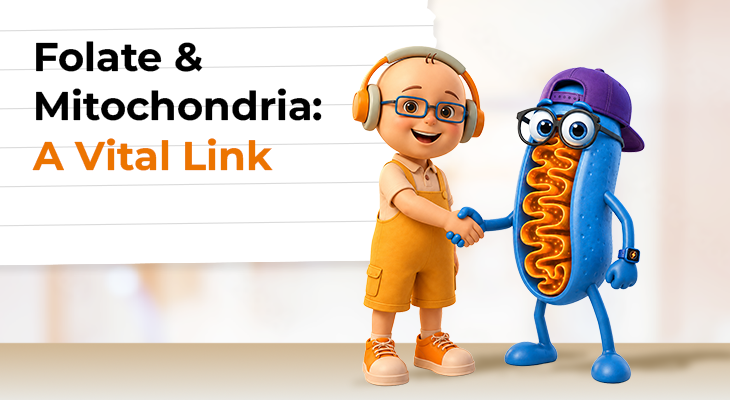
Imagine an intricate dance between two of biology’s most fascinating players: the folate receptor alpha and the mitochondrion. One is the gatekeeper for a vital vitamin (folate aka Vitamin B9), the other is the cell’s powerhouse. Their relationship is not just important; it’s essential for life, energy, and even protection against disease.
While often discussed separately, the folate receptor and mitochondrial function are deeply entwined. The connection is a story of delivery, fuel, and defense – a partnership that, when working correctly, keeps our cells humming and our bodies as healthy as they can be.
The Messenger: Folate and Its Receptors
Folate (Vitamin B9) is a water-soluble vitamin that the body cannot produce on its own. It is crucial for the synthesis, metabolism, and repair of DNA, making it a cornerstone of cellular life. Because folate cannot enter cells on its own, it relies on specialized transporters and receptors. One of the most studied of these is the folate receptor alpha (FRa).
The folate receptor acts like a high-affinity delivery system. It binds to folate on the cell’s surface and ferries it inside, especially in tissues with high metabolic demands. It is essential to have functional folate receptor alpha for proper health. With this in mind, it is important to screen for folate receptor autoantibodies (via the FRAT® test) to ensure that there is no folate transport issue with the receptor as well. Folate receptor autoantibodies will impede folate transfer into the choroid plexus thereby potentially causing cerebral folate deficiency.
The Factory: Mitochondrial Function and One-Carbon Metabolism
Mitochondria are the organelles responsible for generating most of the cell’s energy (ATP) via oxidative phosphorylation. But that’s not all they do. They also house a distinct, parallel version of folate-mediated one-carbon (1C) metabolism. This is a network of chemical reactions that uses folate derivatives as cofactors to perform two critical jobs:
- Nucleotide Synthesis: Providing the building blocks (purines and thymidylate) for DNA replication and repair.
- Methionine Regeneration: Supporting methylation reactions that are crucial for gene regulation (epigenetics) and countless other cellular processes.
The Connection: How FRα Supports Mitochondrial Power
The relationship is built on a very particular pathway: Folate Receptor → Folate Uptake → Mitochondrial One-Carbon Metabolism → Healthy Mitochondria. When this system functions correctly, the benefits are profound.
Recent research has illuminated this partnership. In a 2026 study, scientists found that activating the folate receptor 1 (FOLR1) with folic acid suppressed harmful amyloid-beta production in neurons exposed to high glucose, a condition mimicking diabetic encephalopathy. This protective effect was linked to a significant reduction in mitochondrial reactive oxygen species (ROS – harmful byproducts of metabolism that can damage cells. The researchers concluded that FOLR1 activation mitigates mitochondrial oxidative stress via a STAT3/Nrf2 pathway. In more simple terms, the folate receptor wasn’t just delivering fuel; it was activating a cellular defense system that directly protects mitochondria from damage.
When the System Fails:
If the folate receptor-mitochondria axis is so vital, what happens when it goes wrong?
When folate delivery fails, the consequences are severe for mitochondrial health. Folate deficiency creates a state of “folate stress” that damages both nuclear and mitochondrial DNA.
This occurs because without adequate folate, mitochondrial one-carbon metabolism falters, leading to an imbalance in nucleotide pools. This results in uracil misincorporation into mitochondrial DNA (mtDNA), causing DNA strand breaks and genomic instability. The mitochondria become inefficient, produce more damaging ROS, and in some cases, mitochondrial DNA content is reduced. This mitochondrial dysfunction is a key factor in conditions like megaloblastic anemia, neurodegenerative diseases, and even aging.
Conclusion: A Partnership for Life
The relationship between the folate receptor and mitochondrial function is a fundamental partnership in cellular health. The receptor is the gatekeeper, ensuring the cell’s most essential nutrient for DNA synthesis and repair, folate, gets to its most critical destination-the mitochondria. This supports robust energy production, healthy DNA, and robust defense against oxidative stress.
From neuroprotection to proper neurodevelopment, this connection is proving to be a powerful focal point for understanding and treating disease. As research continues, we are likely to uncover even more intricate details of this partnership, opening new avenues for therapies that can either nourish this relationship or, in the case of cancer, strategically sever it.
References:
- https://snu.elsevierpure.com/en/publications/folate-receptor-1-activation-suppresses-high-glucose-induced-amyl/
- https://pmc.ncbi.nlm.nih.gov/articles/PMC6363433/#2
- https://rupress.org/jcb/article/224/9/e202502205/278210/Mechanisms-of-genome-instability-from-cellular?searchresult=1#4
- https://www.cell.com/trends/pharmacological-sciences/fulltext/S0165-6147(20)30057-2?_returnURL=https%3A%2F%2Flinkinghub.elsevier.com%2Fretrieve%2Fpii%2FS0165614720300572%3Fshowall%3Dtrue