
Download Download & share this Knowledge card in your network [Free Download]
Introduction
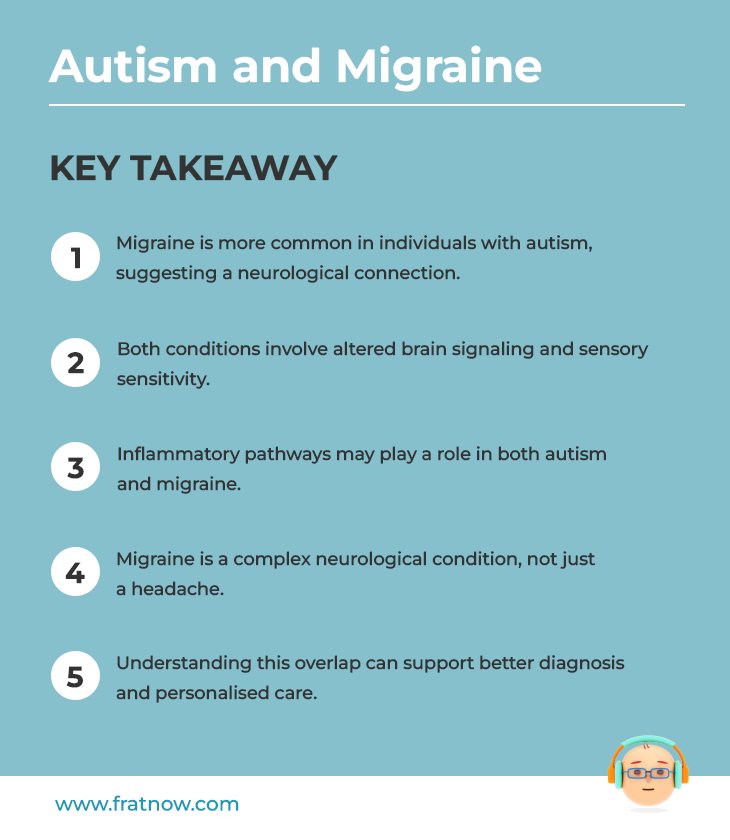
Autism Spectrum Disorder (ASD) is widely understood as a neurodevelopmental condition that affects communication, behavior, and sensory processing. However, emerging research suggests that autism and migraine may be connected through broader neurological patterns. Increasingly, clinicians and researchers are observing a higher occurrence of migraine in autism, raising important questions about shared biological mechanisms.
Migraine is not simply a severe headache. It is a complex neurological condition involving altered brain signaling, sensory sensitivity, and inflammatory responses. Interestingly, several of these same mechanisms have also been studied in autism. Understanding the overlap between autism and migraine headaches may offer valuable insight into underlying neurological processes.
The Neurological Basis of Migraine
Migraine is considered a disorder of brain excitability and sensory processing. Individuals experiencing autism and migraine headaches may report symptoms such as light sensitivity, sound sensitivity, nausea, or visual disturbances. These features are significant because similar sensory differences are frequently observed in autism.
Research suggests that migraine may arise from disruptions in neuronal signaling pathways, especially those involving energy metabolism and immune regulation. These pathways have also been examined in studies exploring autism migraine comorbidity, suggesting that shared biological systems may influence both conditions.
Autism and Sensory Processing
Autism is strongly associated with differences in sensory processing. Individuals may experience heightened sensitivity to light, sound, or environmental stimuli. This becomes particularly relevant when examining:
- Autism and migraines in children, where symptoms may appear as behavioral changes rather than reported pain, and
- Autism and migraine in adults, where migraine symptoms may present more traditionally.
In both groups, sensory overload may influence neurological responses, contributing to the observed overlap between autism and migraine.
Understanding Autism Migraine Comorbidity
The presence of migraine symptoms alongside autism is often described as autism migraine comorbidity. While autism does not directly cause migraine, researchers continue to explore why migraine appears more frequently in some individuals on the spectrum.
Shared contributing factors may include immune signaling differences, metabolic variability, and altered neurological regulation. These influences may help explain why migraine in autism can present differently compared to the general population.
This comorbidity may also influence the frequency, intensity, and triggers of migraine episodes in individuals on the autism spectrum. For instance, heightened sensory sensitivity, differences in stress response, and variations in sleep patterns may all act as contributing factors that shape how migraine manifests. In some cases, common environmental triggers such as bright lights, loud sounds, or changes in routine may overlap with sensory sensitivities already present in autism, increasing neurological strain.
Ongoing research aims to better understand how these shared biological and environmental factors interact over time. By examining patterns of sensory input, immune responses, and metabolic function together, clinicians may be able to more accurately identify migraine-related symptoms within the autism population and support more personalised observation and care strategies.
Download Download & share this infograph card in your network [Free Download]
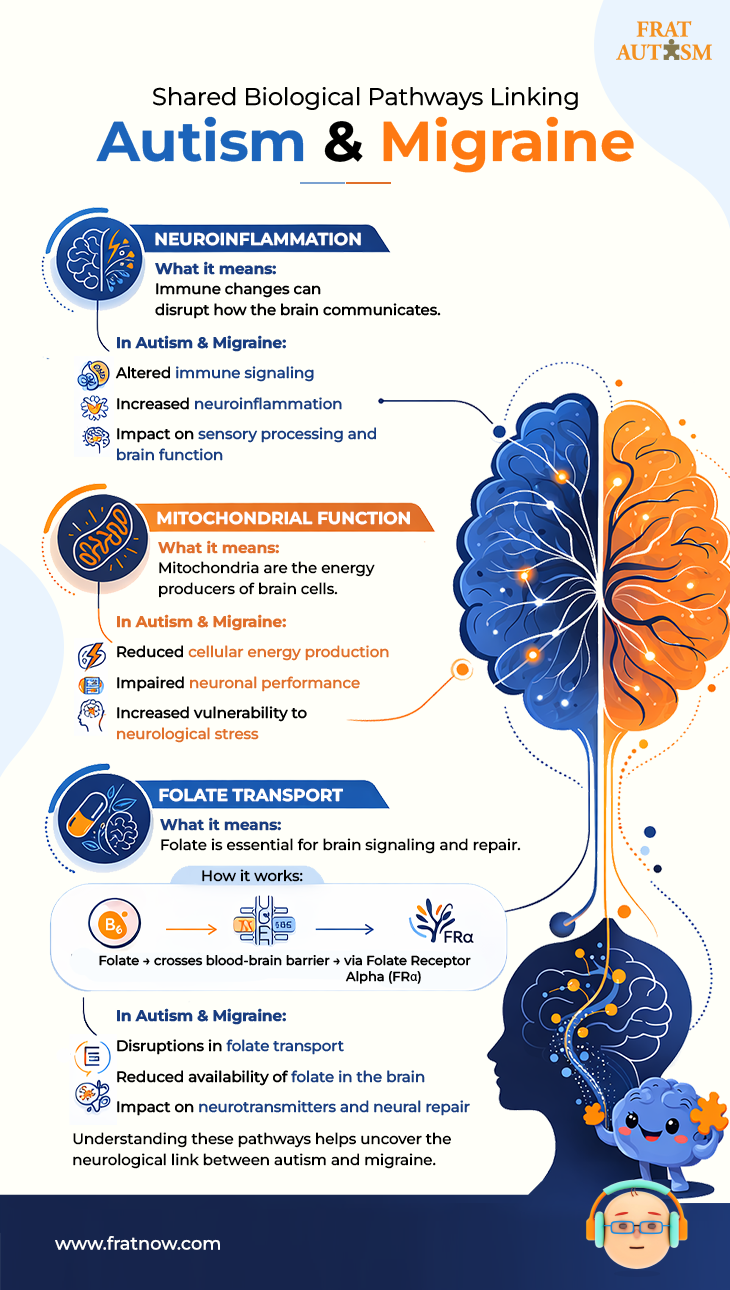
Shared Biological Pathways
Recent studies have highlighted several biological systems that may help explain the relationship between autism and migraine.
Neuroinflammation is one such factor. Both autism and migraine have been associated with altered immune responses that may influence neuronal communication and sensory processing.
Mitochondrial function is another area of interest. Since mitochondria produce energy in brain cells, reduced efficiency in these systems may contribute to sensory processing challenges in autism and increased susceptibility to migraine.
Folate transport is also critical. Folate supports brain signaling, neurotransmitter production, and cellular repair. For folate to function effectively in the brain, it must cross the blood-brain barrier through Folate Receptor Alpha (FRα). Disruptions in this process have been studied in both autism and neurological conditions involving migraine.
The Role of Folate Receptor Autoantibodies
One emerging area of research involves folate receptor autoantibodies (FRAAs). These immune proteins may interfere with folate transport into the brain.
Reduced folate availability may influence neural signaling and sensory regulation. Altered folate transport has been studied in autism and in certain neurological presentations, offering potential insight into cases of migraine in autism.
The presence of folate receptor autoantibodies may contribute to variability in how neurological symptoms are expressed across individuals. Since folate plays a key role in neurotransmitter synthesis, DNA repair, and brain development, even subtle disruptions in its transport can influence cognitive function, mood regulation, and sensory processing. This may help explain why some individuals with autism experience more pronounced sensory sensitivities or episodic neurological symptoms such as migraine.
Ongoing research is also examining how identifying FRAAs may support more targeted clinical investigation into cerebral folate metabolism and broader neuroimmune interactions. While this area is still developing, it highlights the importance of considering nutrient transport and immune responses as part of a comprehensive neurological evaluation.
Clinical Relevance
The overlap between autism and migraine suggests that both conditions may share deeper neurobiological foundations.
When evaluating individuals with:
- Autism and migraine headaches,
- Autism and migraine in adults, or
- Autism and migraines in children
Clinicians may consider exploring underlying biological contributors.
The FRAT® (Folate Receptor Autoantibody Test), is designed to detect FRAAs and support clinical investigation into folate-related neurological pathways. By identifying potential disruptions in folate transport, FRAT® may assist in understanding neurological variability.
It is important to note that this is not an autism migraine treatment, but rather a diagnostic tool that may support informed clinical evaluation.
Conclusion
Autism and migraine are complex neurological conditions that may share overlapping biological mechanisms. The presence of autism migraine comorbidity in some individuals suggests that shared pathways involving immune signaling, mitochondrial function, and folate transport may influence neurological responses.
Understanding these underlying systems may help clinicians better interpret both migraine in autism and sensory regulation differences across age groups.
Expanding awareness of this connection also highlights the value of a more integrated and individualised approach to neurological evaluation. By looking beyond isolated symptoms and considering patterns of sensory sensitivity, metabolic function, and immune regulation together, clinicians may gain a more complete picture of how autism and migraine interact within the same individual. This can be especially meaningful in children or individuals with communication differences, where migraine-related discomfort may present through behaviour, sleep disruption, or changes in sensory tolerance rather than clearly expressed pain. Continued research into shared mechanisms such as neuroinflammation, mitochondrial efficiency, and folate transport may further refine clinical understanding and support more targeted investigations. Over time, this evolving knowledge base has the potential to improve recognition, guide supportive care strategies, and contribute to a more nuanced understanding of neurological diversity across the autism spectrum.
FRAT® Test - Key Facts To Know
Of the 20,000+ individuals tested with the FRAT® test, a significant percentage showed positive results, indicating the presence of Folate Receptor Autoantibodies. Supplementation with alternative treatments like folinic acid has demonstrated improvements in quality of life for many of these individuals.
A FRAT® user’s TikTok video, sharing her child’s positive transformation following a positive FRAT® test result, went viral. Since its posting, the video has garnered an impressive 800K views, 79K likes, 27K shares, 33K bookmarks, and over 3K comments. Watch the video below:
@kyra2532 LIFE CHANGING updates for children with autism. #autismmom #childwithautism #autismresearch #autismfamily ♬ original sound - Kyra
Note: This video is only available in
regions where TikTok is available.
Over the years, more than 1400 physicians have been prescribing the FRAT® Test, underscoring its growing recognition as a valuable diagnostic tool.
Here’s what Maxwell (Parent to an autistic child) has to say about the FRAT® test:

MAXWELL M.