
Download Download & share this Knowledge card in your network [Free Download]
Introduction
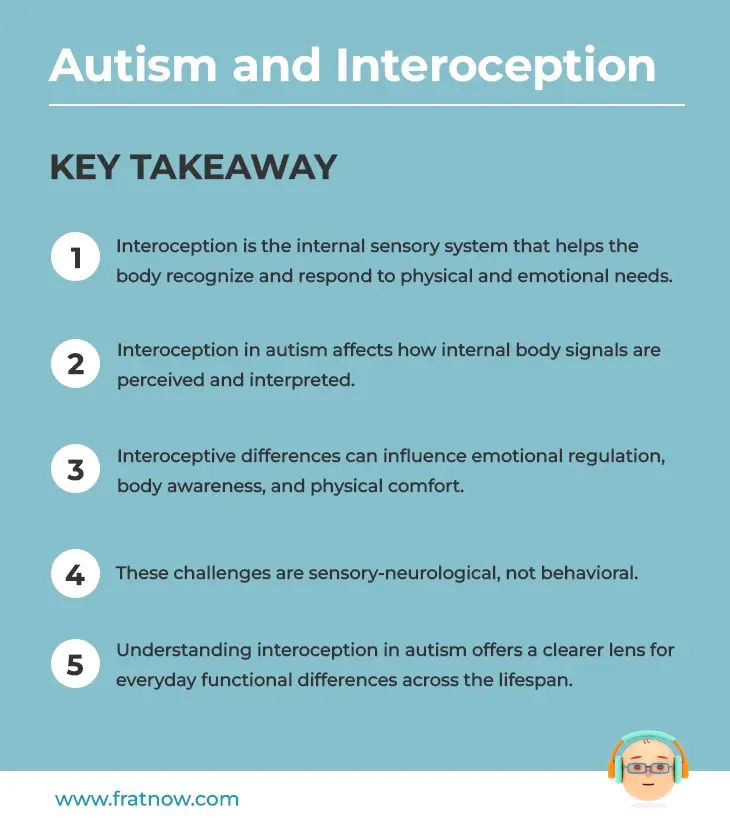
Every day, the human body sends signals that guide basic needs and actions—when to eat, drink, rest, seek warmth, or use the bathroom. These signals operate largely in the background, allowing most people to respond automatically without conscious effort. This internal sensing ability is known as interoception, and it plays a foundational role in physical regulation, emotional awareness, and self-care.
In recent years, research has increasingly explored the relationship between autism and interoception, as many autistic individuals experience differences in how internal body signals are perceived, processed, or interpreted. These differences can affect daily functioning in subtle and sometimes profound ways, influencing emotional regulation, body awareness, and responses to physical discomfort. Understanding interoception and autism helps reframe many everyday challenges as sensory-based rather than behavioral.
This article explains the interoception definition, explores interoception in autism, and examines how internal body signals influence daily life across childhood and adulthood.
Table of Contents
- Introduction
- What is Interoception?
- Interoception as a Sensory System
- Interoception in Autism
- Autism, Interoception, and Body Awareness
- Internal Sensations and Emotional Regulation
- Daily Life Impacts of Interoceptive Difference
- Interoception Across the Lifespan
- Interoception Therapy, Training, and Supportive Approaches
- Interoception in the Broader Autism Research Context
- Conclusion
- Did You Know?
- References
What is Interoception?
Interoception is the sensory system that allows the brain to receive information from inside the body. In simple terms, it helps a person notice and understand internal physical states.
The interoception meaning in English can be described as the body’s ability to sense internal conditions such as hunger, thirst, pain, temperature, heart rate, and breathing. Because these signals come from within the body rather than the external environment, interoception is sometimes referred to as the interoception sense or interoceptive sense.
The term interoceptive awareness refers to how clearly and accurately a person can recognize, interpret, and respond to these internal sensations. Strong interoceptive awareness allows individuals to respond early to bodily needs, while reduced awareness can delay or complicate those responses.
Interoception as a Sensory System
Interoception is part of the broader sensory system, even though it is less visible than sight or hearing. The interoception sensory system continuously monitors internal bodily states and sends this information to the brain for interpretation.
Interoception works closely with other sensory systems, particularly proprioception. Interoception and proprioception are often discussed together because proprioception helps a person understand where their body is in space, while interoception helps them understand how their body feels internally. Together, these systems support coordinated movement, emotional regulation, and bodily self-awareness.
Because interoceptive signals are internal, differences in the interoceptive senses are often misunderstood, especially in neurodevelopmental conditions.
Interoception in Autism
Research suggests that interoception in autism may function differently compared to neurotypical processing. These differences do not look the same in every individual, but they commonly involve challenges with detecting, interpreting, or responding to internal body signals.
In autism, interoceptive signals may be muted, delayed, inconsistent, or overwhelming. This variability helps explain why the relationship between interoception and autism is complex and highly individualized. Some autistic individuals may not notice internal sensations until they become intense, while others may experience internal sensations very strongly but struggle to understand what those sensations mean.
These patterns are central to understanding autism interoception and how internal sensory processing shapes everyday experiences.
Autism, Interoception, and Body Awareness
Interoception plays a critical role in autism body awareness. When internal signals are unclear or difficult to interpret, a person may experience body awareness problems, including a lack of body awareness.
For individuals with body awareness autism challenges, it may be difficult to recognize physical discomfort, fatigue, hunger, or stress until those sensations become overwhelming. This does not reflect inattentiveness or avoidance; rather, it reflects differences in how the brain processes internal sensory information.
Over time, these challenges can affect self-care, emotional regulation, and communication of physical needs, particularly in children who may not yet have the language to describe internal sensations.
Internal Sensations and Emotional Regulation
Emotional experiences are closely linked to the body. Changes in heart rate, breathing, muscle tension, and gut activity all contribute to how emotions are felt and understood. For this reason, interoception plays a central role in emotional awareness.
When internal sensations are difficult to interpret, emotions may feel sudden, intense, or confusing. In autism, this can affect emotional regulation, stress responses, and the ability to identify or label feelings. What may appear externally as anxiety, irritability, or withdrawal often reflects difficulty processing internal bodily cues rather than emotional disinterest.
Understanding this connection is essential when examining interoception in autism from a sensory and neurological perspective.
Daily Life Impacts of Interoceptive Differences
Differences in interoceptive processing can influence many aspects of daily life.
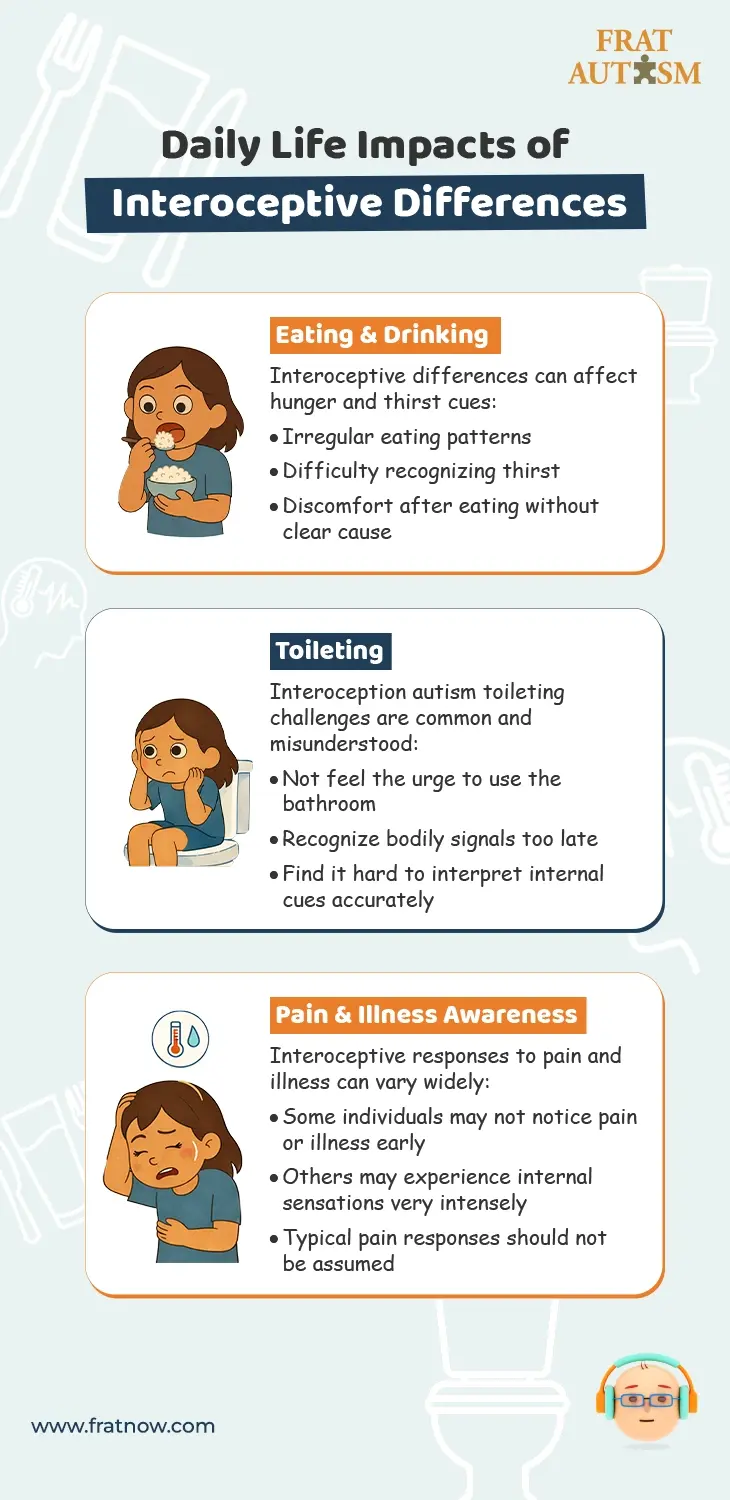
Eating and drinking may be affected when hunger or fullness cues are unclear. Some individuals may not feel hungry until energy levels drop significantly, while others may experience discomfort without being able to identify its source. Similarly, recognizing thirst can be difficult, leading to inconsistent hydration.
Interoception-related toileting challenges in autism are also common. The internal cues that signal the need to use the bathroom may be delayed, subtle, or confusing, which can affect both children and adults. These experiences are sensory-based and should not be interpreted as intentional or behavioral.
Pain and illness awareness may also differ. Some autistic individuals may not recognize pain or physical illness early, while others may experience strong internal sensations that are difficult to describe or localize.
Download Download & share this infograph card in your network [Free Download]
Interoception Across the Lifespan
Interoceptive differences do not disappear with age. Interoception in autistic adults often involves ongoing challenges related to fatigue, stress awareness, burnout, and physical self-monitoring. Adults may struggle to recognize early signs of exhaustion or illness, which can impact mental health and overall well-being.
Recognizing interoception as a lifelong sensory process supports more accurate understanding and self-advocacy across the lifespan.
Interoception Therapy, Training, and Supportive Approaches
It is important to note that interoception therapy does not refer to a medical treatment. Instead, it describes supportive, educational approaches commonly used in occupational therapy and developmental support.
Interoception training or interoceptive training focuses on helping individuals become more aware of their internal body signals and build language around those sensations. Similarly, interoception exercises and interoception activities for autism are designed to support awareness and regulation rather than change neurological differences.
An interoception assessment conducted by trained professionals can help identify how an individual experiences internal sensations and guide appropriate supportive strategies.
Interoception in the Broader Autism Research Context
Growing interest in interoception reflects a broader shift toward understanding autism through biological and sensory frameworks. Research into metabolism, sensory processing, and neurodevelopment continues to expand knowledge of how internal systems influence behavior and daily functioning.
Tools such as FRAT® support scientific investigation into neurological and developmental conditions by identifying folate receptor autoantibodies (FRAAs), which are associated with cerebral folate deficiency in some individuals with ASD.
While interoception research and FRAAs testing address different biological pathways, both reflect the movement toward a precision-based understanding of autism.
Conclusion
The relationship between autism and interoception offers valuable insight into how internal body signals shape daily functioning, emotional awareness, and self-care. Differences in interoception in autism can affect body awareness, emotional regulation, eating, toileting, and recognition of physical needs across the lifespan.
By understanding interoception and autism through a sensory and biological lens, clinicians, caregivers, and individuals can better interpret challenges that are often misunderstood. Continued research into interoceptive processing contributes to a more accurate, compassionate, and science-driven understanding of autism.
FRAT® Test - Key Facts To Know
Of the 20,000+ individuals tested with the FRAT® test, a significant percentage showed positive results, indicating the presence of Folate Receptor Autoantibodies. Supplementation with alternative treatments like folinic acid has demonstrated improvements in quality of life for many of these individuals.
A FRAT® user’s TikTok video, sharing her child’s positive transformation following a positive FRAT® test result, went viral. Since its posting, the video has garnered an impressive 800K views, 79K likes, 27K shares, 33K bookmarks, and over 3K comments. Watch the video below:
@kyra2532 LIFE CHANGING updates for children with autism. #autismmom #childwithautism #autismresearch #autismfamily ♬ original sound - Kyra
Note: This video is only available in
regions where TikTok is available.
Over the years, more than 1400 physicians have been prescribing the FRAT® Test, underscoring its growing recognition as a valuable diagnostic tool.
Here’s what Maxwell (Parent to an autistic child) has to say about the FRAT® test:

MAXWELL M.