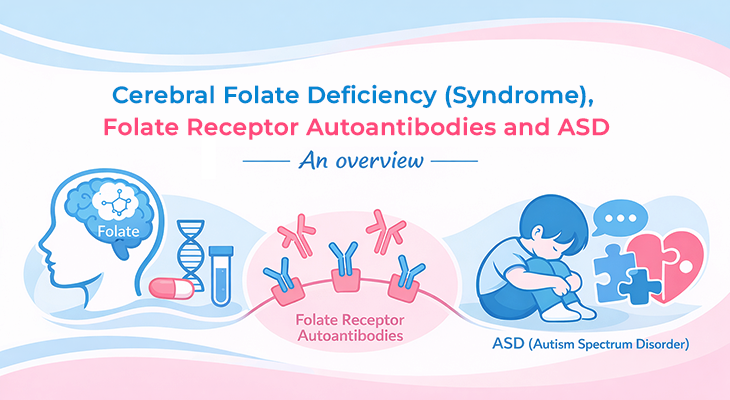


Autism spectrum disorder (ASD) is famously heterogeneous—a single label that encompasses a wide array of biological and clinical realities. For years, this heterogeneity has frustrated efforts to find broadly effective treatments, as interventions that show promise in one group of children may show little benefit in another. A growing body of research, however, is moving toward a biomarker-based approach, identifying distinct biological subtypes within the autism spectrum. One of the most compelling and clinically actionable of these is the FRAA (folate receptor autoantibodies) – positive, mitochondrial-dysfunction phenotype. This subtype is defined by a specific, measurable biological signature (folate receptor autoantibodies detected by the FRAT® test) that not only deepens our understanding of autism’s underlying biology but also points toward a targeted, and in some cases remarkably effective, treatment.
The Biology: A Tale of Two Transporters
To understand this phenotype, we must first look at the intersection of two critical systems: folate transport into the brain and cellular energy production.
The Folate Pathway and FRAAs
Folate (vitamin B9) is essential for brain development and function. A specific form, 5-methyltetrahydrofolate (5-MTHF), is the primary active folate in the central nervous system. To get from the blood into the brain, 5-MTHF must pass the blood-brain barrier via a specialized transport system. The key transporter is the folate receptor alpha (FRα), which pumps folate into the brain through an ATP-dependent (energy-requiring) process. They key piece here is “energy”.
When this transport system fails, a condition called cerebral folate deficiency syndrome (CFDS) occurs—low folate in the brain despite normal levels in the blood. One major cause of CFDS is the presence of folate receptor alpha autoantibodies (FRAAs). These are antibodies that mistakenly target and block or bind to the FRα, impairing its ability to transport folate into the brain. Studies have found that a striking ~71% of children with ASD are positive for FRAAs, compared to a much lower rate in the general population, making them ~19 times more likely to have these autoantibodies.
The Mitochondrial Connection
This is where mitochondria—the cell’s power plants—enter the story. Because FRα-mediated folate transport is ATP-dependent, mitochondria must supply the energy for this process to work. Mitochondrial dysfunction is well-documented in a substantial subset of individuals with ASD, characterized by reduced ATP production, increased oxidative stress, and impaired mitochondrial dynamics. When mitochondria are not functioning optimally, the energy supply for the FRα transporter can falter, leading to CFDS even in the absence of FRAAs. This creates a dual-hit scenario: a child may have CFDS driven by autoimmune blockade of the transporter (FRAAs), by energy failure (mitochondrial dysfunction), or, most commonly, by a combination of both.
The Phenotype: A Treatable Subtype?
The clinical picture of children with this combined FRAA-positive and mitochondrial-dysfunction profile is not yet fully delineated, but research is beginning to reveal a distinct pattern of features and, crucially, a specific treatment response.
Clinical Features
Children with CFDS and FRAAs can present with a range of neurological and developmental symptoms. Core autistic features are prominent, but the phenotype often extends to include:
- Language and Communication Deficits: This is a particularly salient feature. Many children in this subgroup exhibit significant language delay, and verbal communication is a primary outcome that improves with targeted treatment.
- Neurological Signs: Seizures, movement disorders (such as ataxia or dyskinesias), and pyramidal tract signs (like spasticity) are frequently reported in CFD.
- Developmental Regression: Some children may experience a loss of previously acquired skills, particularly in the context of the broader CFD syndrome.
Furthermore, research suggests that the type of FRAA matters. Children positive for blocking FRAAs appear to have a somewhat more favorable profile, with better communication scores on adaptive behavior scales compared to those with binding FRAAs.
The “Off-Label” Use of Leucovorin (Folinic Acid)
The most significant implication of identifying this subtype is its potential for treatment. The standard treatment, although not approved by the FDA and used “off label” for CFDS is leucovorin (folinic acid), a reduced form of folate. Unlike folic acid, leucovorin can bypass the blocked FRα transporter and enter the brain through an alternative route, the reduced folate carrier (RFC).
Clinical trials have shown that leucovorin can produce meaningful improvements in children with ASD and CFD, but the benefits are most pronounced in the FRAA-positive subgroup:
- A meta-analysis found that in individuals with ASD and CFD, leucovorin led to improvements in overall symptoms (67%), irritability (58%), and even neurological signs like ataxia (88%).
- Placebo-controlled trials have demonstrated significant gains in verbal communication with medium-to-large effect sizes, with FRAA-positive children being more likely to respond.
- The treatment is generally well-tolerated, with side effects that are typically mild and transient, such as agitation or headaches.
This stands in stark contrast to the broader, often disappointing results when leucovorin is tested in unselected autism populations. The difference is the “dilution effect”: in a heterogeneous group, the significant gains in the treatable subgroup are statistically washed out by the non-responders. This highlights a critical lesson: targeting the right biological subtype is essential for demonstrating treatment efficacy.
From Subtype to Standard of Care
The FRAA-positive, mitochondrial-dysfunction phenotype represents a paradigm shift in how we think about autism. It moves the conversation from a purely behavioral diagnosis to one that incorporates measurable, treatable biological markers. However, significant work remains. The field needs larger, biomarker-stratified clinical trials to confirm these findings and to standardize protocols for FRAA testing and leucovorin dosing. There is also a need to better understand the natural history of this subtype and the long-term outcomes of early intervention.
For now, this research offers a message of both hope and caution. It provides a clear, biologically plausible explanation for why some children with autism respond dramatically to a simple vitamin derivative while others do not. It also underscores that autism is not one condition, but many—and that the future of effective treatment lies in looking beneath the behavioral surface to the underlying biology.