
Table of Contents
- Introduction
- Early Childhood as the Brain’s Most Transformative Stage
- Children’s Brains Are Different
- What Makes a Child’s Brain Special?
- Experience Shapes the Fate of Early Neural Connections
- What Does It Mean for Children to Be “SuperLearners”?
- Why Children Sometimes Outperform Adults in Complex Skills
- The DoubleEdged Nature of ExperienceDependent Plasticity
- The High Stakes of Early Experience
- Take Home Messages
- Summary and Conclusion
- Knowledge Gaps
- Future Directions
- Closing Perspective
- Did You Know About Folate Receptor Autoantibodies (FRAAs) and Brain Development?
- References
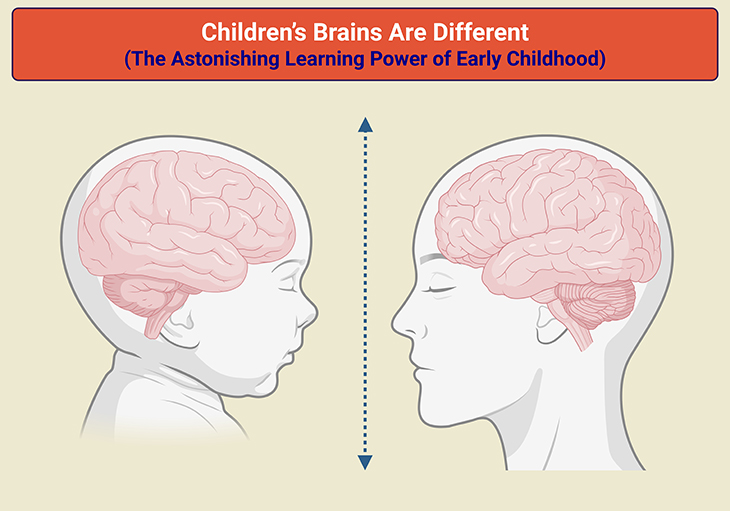
Figure 1. Children’s Brain are Different ~ The Astonishing Learning Power of Early Childhood. Children’s brains are built for change. In early life, neural circuits are wide open to experience — forming, pruning, and reorganizing at a pace where the adult brain can no longer match. Every wobbling step, every curious reach, every repeated attempt reshapes the architecture of learning. This openness fuels extraordinary mastery but also heightens vulnerability: enriching experiences strengthen pathways, while stress or deprivation can divert development. Autism emerges within this sensitive window, when early differences can ripple across networks — yet this same plasticity makes early intervention uniquely powerful. In essence: children learn differently because their brains change differently — rapidly, deeply, and in direct response to the world they explore.
Introduction
Early Childhood as the Brain’s Most Transformative Stage
Children move through the world with a kind of fearless experimentation that adults rarely match. They fall, get up, try again, and repeat this cycle thousands of times a day. They babble their way into language, explore movements with joyful variability, and absorb new skills with a persistence that borders on relentless. Beneath these behaviors lies a deeper biological truth: the early brain is wired for change. It is a system built to be shaped, refined, and reorganized by experience.
During infancy and early childhood, neural circuits are not yet fixed; they are actively competing, strengthening, weakening, and reorganizing in response to what the child sees, hears, touches, and attempts. Synapses form at staggering rates, and the brain continuously evaluates which connections to keep and which to prune. This means that experience is not simply enriching — it is instructive, determining the fate of entire networks. A child who practices a skill intensely, whether walking or skiing or learning a new language, literally sculpts the architecture that supports that skill [1-6].
But this remarkable openness comes with a paradox. Children often learn more slowly than adults in certain domains — they take longer to acquire vocabulary, longer to master grammar, longer to refine motor precision. Yet, given enough time and practice, they can ultimately reach higher levels of proficiency than adults ever can. Their advantage lies not in speed, but in the depth and durability of the circuits they build.
This developmental landscape is especially relevant for neurodevelopmental disorders, including autism. Autism does not emerge in a vacuum; it arises during a period when the brain is most dependent on experience to guide its wiring. If early circuits develop atypically — whether through altered sensory processing, reduced exploration, heightened variability, or differences in how prediction and feedback are integrated — these early deviations can cascade across the system. The same mechanisms that allow children to master complex skills can, when disrupted, amplify developmental differences [7-10].
This is why early intervention is not optional — it is biologically essential. Intervening during a period when the brain is still selecting, strengthening, and pruning connections allows us to influence circuits while they remain malleable. For children with autism, early intervention can support communication pathways, stabilize motor patterns, enhance social engagement, and reduce the long-term impact of atypical early wiring. The earlier we align experience with the brain’s natural windows of plasticity, the more effectively we can guide developmental trajectories.
Yet plasticity is a double-edged force. The same openness that fuels learning also makes the young brain uniquely vulnerable. Stress, deprivation, sensory disruption, or lack of stimulation can alter circuits in ways that persist into adulthood. A patched eye can permanently change visual cortex. Limited language exposure can slow literacy. Chronic adversity can reshape emotional and cognitive networks. In early life, every experience — and every absence of experience — leaves a trace.
Understanding this interplay between plasticity, experience, and vulnerability is central to understanding autism. It reveals why early differences matter, why early support is powerful, and why the first years of life represent both a window of extraordinary opportunity and a period of profound sensitivity.
As we move forward in this series, we will explore how these early mechanisms shape development, how they differ in autism, and how science can harness this knowledge to support children during the most transformative stage of their lives.
Children’s Brains Are Different
The Astonishing Learning Power of Early Childhood
Not long ago, I returned to skiing after many years away from the slopes. Out of shape and decidedly rusty, I cautiously navigated one of the beginner runs. Then, without warning, a tiny child shot across my path like a comet. I swerved, lost my balance, and ended up in the snow—one ski in one direction, a pole in another. The child, who looked barely old enough to form full sentences, was already halfway down the hill. My first reaction was irritation—Where were his parents? Should a child that young be skiing alone? But as I watched more of these small children effortlessly carve down steep terrain, my frustration gave way to awe. How do such young children learn complex motor skills so quickly and so well?
This phenomenon is not limited to skiing. Very young children often acquire skills—athletic, linguistic, musical—far more readily than adults. Coaches, teachers, and developmental specialists consistently emphasize that to become an elite tennis player, a concert violinist, or a native-level bilingual speaker, one must begin early. This raises a profound question: What makes a child’s brain so uniquely equipped for learning? Are children universally “super-learners,” or are there trade-offs to this remarkable capacity? And importantly, what does this mean for understanding developmental conditions such as autism?
Although the full story is still unfolding, neuroscience has uncovered several compelling clues.
What Makes a Child’s Brain Special?
Ask nearly any neuroscientist, and the answer comes quickly: “A child’s brain is more plastic.” But this statement, while true, is incomplete. What exactly is plasticity? What mechanisms create it? And why does it diminish with age?
For our purposes, we can define plasticity as the brain’s ability to modify its connections and functions in response to experience. This capacity emerges from a constellation of cellular, molecular, and circuit-level processes that are especially active early in life.
One of the most striking features of early brain development is the explosive growth of neural connections during infancy and early childhood. By the age of two, a child’s brain contains twice as many synaptic connections as an adult brain. During this period, synapses form at astonishing rates—hundreds of new synapses every second, according to some estimates. This is not a static architecture; it is a highly dynamic, continuously shifting network (see Figure 1; 2) [1-2].
Chemical cues in the developing brain help guide axons toward appropriate targets and repel them from incorrect ones, ensuring that circuits wire up with remarkable precision. But this early abundance of connections is not permanent. Throughout childhood and adolescence, the brain undergoes extensive synaptic pruning, gradually refining its networks until they reach adult levels of efficiency and specialization.
This developmental choreography—rapid synapse formation followed by selective elimination—is one of the core biological engines of early plasticity.
Experience Shapes the Fate of Early Neural Connections
One of the most powerful forces determining whether early neural connections are strengthened or eliminated is use. In infancy and early childhood, the variety, intensity, and quality of a child’s experiences exert profound influence on which synapses survive. Connections that are repeatedly engaged as a child moves, listens, sees, thinks, and feels are the ones most likely to be stabilized [3]. In contrast, connections that remain idle are gradually weakened or removed. Through this process, the architecture of the child’s brain becomes optimized for the specific skills and environments they encounter—whether that means learning to speak Mandarin, mastering the violin, or developing the coordination required for professional tennis.
This description is, of course, a simplified window into the astonishingly complex molecular and circuit-level processes unfolding in early development. Yet the principle remains clear: experience-dependent plasticity in childhood is a major driver of the heightened learning abilities observed in young children for certain behaviors (see Figure 2).
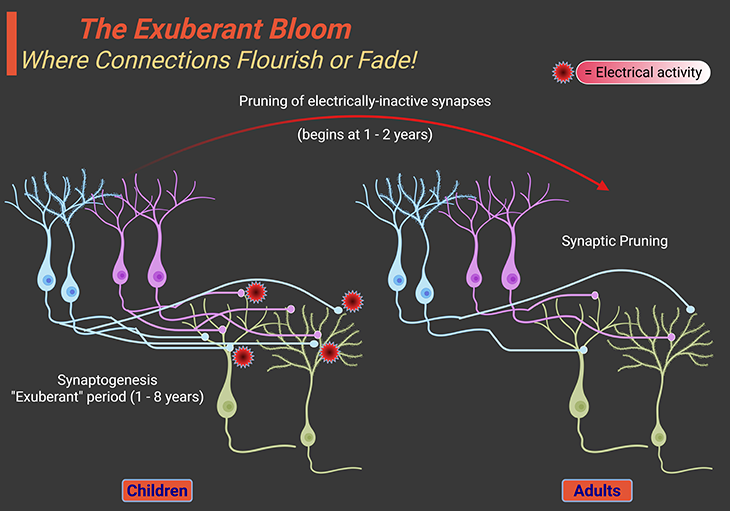
Figure 2. The Exuberant Bloom ~ Where Connections Flourish or Fade. Synaptogenesis → Synaptic Pruning. During the early “exuberant” phase of brain development, children’s neurons erupt with possibility, producing twice as many synapses as the mature brain will ultimately keep. These budding connections—shown as small light pink and blue dots at axon terminals—reflect the storm of synaptogenesis that marks early life. As the child encounters the world, experience and electrical activity act as sculptors, deciding which synapses endure and which are pared away through synaptic pruning. Although no new neurons are typically added after birth, dendrites and synapses branch outward with astonishing speed, thickening the cerebral cortex and weaving circuits of growing complexity.
What Does It Mean for Children to Be “Super-Learners”?
We often imagine children as universally superior learners, but this assumption depends entirely on how we define learning ability. Learning can be evaluated in multiple ways—speed, amount, accuracy, quality, and long-term retention—and different forms of learning rely on distinct neural systems. As a result, exceptional performance in one domain does not necessarily generalize to another.
Take second-language acquisition. Children are “super-learners” in the sense that they can ultimately achieve native-like proficiency, something adults rarely accomplish. However, this does not mean children learn faster. In fact, children acquire vocabulary, reading skills, and grammatical structures more slowly than adults. Their advantage lies not in speed but in the final level of mastery they can attain.
A similar pattern emerges in motor learning. Research shows that younger children actually learn new movements at a slower rate than adults. Their motor learning speed gradually increases throughout childhood and becomes adult-like around age twelve. Children also begin with lower baseline motor proficiency—their movements are more variable and less accurate. This reduced precision likely reflects the ongoing maturation of brain regions responsible for motor control, including the cerebellum, basal ganglia, and motor cortex.
Why Children Sometimes Outperform Adults in Complex Skills
If children learn new movements more slowly and with greater variability, why do they often appear to master certain tasks—like skiing—more naturally than adults? Several factors converge to create this paradox.
First, children’s smaller bodies and lower centers of mass give them a natural biomechanical advantage in activities that require balance and rapid adjustments. This helps explain why skiing may feel more intuitive for a child than for an adult. But this alone cannot account for their proficiency in fine motor skills, such as video gaming, where only the hands are involved.
A second factor is that children’s movement variability—often viewed as a weakness—may actually be a strength. Young children naturally explore a wide range of movement patterns, testing multiple strategies before settling on the most effective one. This exploratory behavior is a cornerstone of motor learning, allowing children to discover optimal solutions that adults, who tend to rely on familiar patterns, may never attempt.
The third—and perhaps most powerful—factor is children’s extraordinary willingness to practice. Infants learning to walk take roughly 2,400 steps per hour and fall seventeen times in that same period. This means they traverse the equivalent of seven American football fields per hour. Over six active hours in a day, they may fall one hundred times and cover the distance of forty-six football fields. This relentless practice, combined with the heightened experience-dependent plasticity of the developing brain, allows children to achieve levels of motor mastery that adults rarely match [4].
The Double-Edged Nature of Experience-Dependent Plasticity
Yet the same plasticity that fuels children’s remarkable learning abilities also makes them uniquely vulnerable. The developing brain does not distinguish between positive and negative experiences—all experiences leave a mark.
Children exposed to chronic stressors such as neglect, abuse, or poverty face significantly increased risks of anxiety, emotional dysregulation, and cognitive impairments. These outcomes are not merely immediate reactions to adversity; they reflect lasting alterations in neural circuitry, particularly in systems governing emotion, stress regulation, and executive function [6].
Similarly, the absence of critical experiences can be profoundly damaging. For example, prolonged patching of one eye in early childhood—thereby depriving the visual system of normal input—can lead to irreversible changes in the development of visual cortex and long-term deficits in depth perception. Likewise, children who are not read to during early childhood often show slower language acquisition and poorer literacy outcomes, reflecting missed opportunities to strengthen the neural networks that support language and reading [5-6].
The High Stakes of Early Experience
In the end, early development is shaped by a simple but powerful truth: every experience counts, and so does the absence of experience. Children can harness early plasticity to master skills—from skiing to speaking French—that adults struggle to acquire. But this same plasticity also renders them susceptible to the harmful effects of stress, deprivation, and disrupted environments.
Although scientists have not yet fully mapped the mechanisms that drive childhood brain plasticity, one conclusion is unmistakable: early life experiences exert extraordinary influence on the developing brain. Future research will continue to illuminate how we can protect, enrich, and optimize this remarkable window of human potential.
Take-Home Messages
- Early neural connections survive or disappear based on use, making everyday experiences a powerful sculptor of the developing brain.
- Experience-dependent plasticity allows children to optimize their brains for the specific environments and skills they engage in, from language to athletics to fine motor expertise.
- Children are not universal “super-learners”; their advantage depends on the type of learning, the metric used (speed, proficiency, retention), and the neural systems involved.
- Children often learn more slowly than adults in domains such as language acquisition and motor skill formation, yet they can ultimately reach higher levels of proficiency.
- Movement variability and exploration, common in young children, serve as powerful engines of motor learning, enabling them to discover optimal movement strategies adults may never attempt.
- The intensity of children’s practice—such as infants taking ~2,400 steps/hour and falling 17 times/hour—combines with heightened plasticity to produce exceptional learning outcomes.
- Plasticity is a double-edged sword: it enhances learning but also increases vulnerability to stress, deprivation, and adverse experiences, which can produce lasting changes in neural circuitry.
- Lack of critical experiences—such as visual deprivation or limited language exposure—can lead to irreversible developmental consequences in sensory, cognitive, and literacy domains.
- Ultimately, every experience—and the absence of experience—matters profoundly in early life, shaping the architecture and function of the developing brain.
- While the mechanisms of childhood plasticity are not fully understood, it is clear that early environments hold extraordinary power, offering both remarkable opportunities and significant risks.
(Cf. previous blogs entitled as: “When the Brain Builds Itself.”; “The Neurotypical Brain versus the Autistic Brain – Neurotypical Brain Development and Function.”)
Summary and Conclusions
Early childhood represents a period of extraordinary neural possibility, where the brain’s architecture is shaped moment by moment by the child’s actions, sensations, and experiences. During this window, synapses proliferate at astonishing rates, circuits reorganize continuously, and the fate of neural connections is determined largely by use. Experiences that engage perception, movement, language, and social interaction strengthen the underlying circuits; those that remain unused are weakened or eliminated. This dynamic interplay between activity and pruning allows children to build highly specialized skills — from skiing to speaking a second language — even though they often learn more slowly and with greater variability than adults.
Children’s apparent superiority in mastering certain complex skills arises not from faster learning, but from a combination of biomechanical advantages, greater movement exploration, and an unparalleled willingness to practice. Infants, for example, take roughly 2,400 steps per hour, fall 17 times, and traverse the distance of seven football fields — a level of repetition that adults rarely approach. This intensity of practice, paired with heightened experience-dependent plasticity, enables children to ultimately achieve levels of proficiency that adults seldom reach.
Yet this same plasticity that fuels remarkable learning also creates profound vulnerability. The developing brain does not discriminate between positive and negative experiences — all experiences leave a trace. Chronic stress, neglect, abuse, or poverty can alter emotional and cognitive circuits in lasting ways. Sensory deprivation, such as prolonged monocular occlusion, can permanently disrupt visual development. Limited early language exposure can slow literacy and weaken foundational linguistic networks. In early life, the absence of experience can be as consequential as the presence of harmful experience.
These principles are especially relevant for neurodevelopmental disorders, including autism [7-10]. Autism emerges during a period when circuits are still forming, still competing, and still dependent on experience to guide their refinement. Differences in early sensory processing, reduced exploration, atypical motor variability, or altered prediction-error signaling may shift the developmental trajectory of entire networks. Because early circuits influence the maturation of distant regions — a phenomenon consistent with developmental diaschisis — early deviations can cascade across the brain. This underscores why early intervention is biologically aligned with the core mechanisms of development: it allows us to shape circuits while they remain malleable, before patterns become entrenched.
Knowledge Gaps
Despite major advances, several critical questions remain unanswered:
- What molecular signals determine why some circuits remain plastic longer than others? Sensitive periods vary across domains, but the mechanisms controlling their opening and closure are not fully understood.
- How do early motor and sensory differences in autism propagate across the brain? We know early disruptions can alter distant circuits, but the precise pathways and timing remain unclear.
- Why do children show slower learning rates yet achieve higher ultimate proficiency? The balance between exploration, variability, and consolidation is still being mapped.
- What distinguishes adaptive from maladaptive plasticity? The same mechanisms that support learning can amplify vulnerability, but the boundary between the two is not well defined.
- How do environmental factors interact with genetic predispositions in shaping early circuits? Autism reflects a complex interplay of genes and experience, but the timing and mechanisms of this interaction remain incompletely understood.
Future Directions
Future research will need to:
- Map sensitive periods with greater precision, identifying when specific circuits are most receptive to intervention.
- Characterize early biomarkers of atypical development, enabling earlier and more targeted support for children at risk for autism.
- Develop interventions that harness natural exploration, variability, and practice — the very ingredients that drive children’s learning.
- Understand how stress, adversity, and deprivation alter developmental trajectories, and how these effects can be mitigated or reversed.
- Investigate the cerebellum’s role in early prediction and multisensory integration, a promising frontier for understanding autism’s origins.
- Design personalized early-intervention strategies that align with each child’s unique developmental profile and neural timing.
Closing Perspective
Ultimately, early childhood is a time when the brain is both most capable of transformation and most sensitive to disruption. Children’s remarkable learning abilities — and their vulnerabilities — arise from the same biological engine: experience-dependent plasticity. For neurodevelopmental disorders such as autism, this means that early experiences are not merely beneficial; they are foundational. By understanding how early circuits form, adapt, and sometimes diverge, we gain the power to support children during the most formative stage of life — shaping trajectories, strengthening resilience, and opening pathways for learning that endure across the lifespan.
Did You Know? Folate Receptor Autoantibodies (FRAAs) may impede proper folate transport.
Folate (vitamin B9) is very important for your child’s brain development!
During pregnancy, it helps prevent neural tube defects and plays a big role in forming a normal and healthy baby’s brain and spinal cord. Folate also helps cells divide and assists in both DNA and RNA synthesis.
Emerging research suggests that the presence of FRAAs negatively impacts folate transport into the brain.
- Recent studies reveal that a large subgroup of children with autism spectrum disorder (ASD) have FRAAs.
- This suggests that a possible disruption in folate transport across the blood-cerebrospinal fluid (CSF) barrier may potentially influence ASD-linked brain development.
- Screening for the FRAAs in your child should be part of your early intervention strategies.
Is there a test for identifying Folate Receptor Autoantibodies (FRAAs)?
Yes, there is a test – The Folate Receptor Antibody Test (FRAT®) has emerged as a diagnostic tool for detecting the presence of FRAAs.
It is important to screen at an early age or as soon as possible as there may be corrective measures available. Please consult your physician for further information.
To request a test kit, click on the button below.

For information on autism monitoring, screening and testing please read our blog.
References
- Stiles J, Jernigan TL. The basics of brain development. Neuropsychol Rev. 2010 Dec;20(4):327-48. doi: 10.1007/s11065-010-9148-4. Epub 2010 Nov 3. PMID: 21042938; PMCID: PMC2989000.
https://pubmed.ncbi.nlm.nih.gov/21042938/
(Provides an overview of some very basic principles of brain development, drawn from contemporary developmental neurobiology.) - Innocenti GM, Price DJ. Exuberance in the development of cortical networks. Nat Rev Neurosci. 2005 Dec;6(12):955-65. doi: 10.1038/nrn1790. PMID: 16288299.
https://pubmed.ncbi.nlm.nih.gov/16288299/
https://web.mit.edu/~tkonkle/www/BrainEvolution/Meeting6/Innocenti%202005%20NRN.pdf
(Establishes the relative roles of pre-specified connectivity and exuberance-section in the formation of neural circuits, drawn on data from biological experiments.) - Hensch TK. Critical period mechanisms in developing visual cortex. Curr Top Dev Biol. 2005;69:215-37. doi: 10.1016/S0070-2153(05)69008-4. PMID: 16243601.
https://pubmed.ncbi.nlm.nih.gov/16243601/
(The foundational blueprint for understanding sensitive periods and the molecular logic of early plasticity.) - Adolph KE, Cole WG, Komati M, Garciaguirre JS, Badaly D, Lingeman JM, Chan GL, Sotsky RB. How do you learn to walk? Thousands of steps and dozens of falls per day. Psychol Sci. 2012;23(11):1387-94. doi: 10.1177/0956797612446346. Epub 2012 Oct 19. PMID: 23085640; PMCID: PMC3591461.
https://pubmed.ncbi.nlm.nih.gov/23085640/
(The definitive empirical evidence for infants’ ~2,400 steps/hour and ~17 falls/hour — the cornerstone of your motor-learning argument.) - Kuhl PK. Brain mechanisms in early language acquisition. Neuron. 2010 Sep 9;67(5):713-27. doi: 10.1016/j.neuron.2010.08.038. PMID: 20826304; PMCID: PMC2947444.
https://pubmed.ncbi.nlm.nih.gov/20826304/
https://www.cell.com/action/showPdf?pii=S0896-6273%2810%2900681-1
(Explains why children achieve higher ultimate proficiency in language despite slower learning rates — essential for your “super-learner” nuance.) - McEwen BS, Morrison JH. The brain on stress: vulnerability and plasticity of the prefrontal cortex over the life course. Neuron. 2013 Jul 10;79(1):16-29. doi: 10.1016/j.neuron.2013.06.028. PMID: 23849196; PMCID: PMC3753223.
https://pubmed.ncbi.nlm.nih.gov/23849196/
(A landmark synthesis on how stress and adversity reshape neural circuits during early development — critical for your “double-edged plasticity” argument.) - Wang SS, Kloth AD, Badura A. The cerebellum, sensitive periods, and autism. Neuron. 2014 Aug 6;83(3):518-32. doi: 10.1016/j.neuron.2014.07.016. PMID: 25102558; PMCID: PMC4135479.
https://pubmed.ncbi.nlm.nih.gov/25102558/
(The seminal paper linking early cerebellar disruption to a 40-fold increased autism risk — the strongest evidence for timing-dependent vulnerability.) - Zhu Y, Wang MJ, Crawford KM, Ramírez-Tapia JC, Lussier AA, Davis KA, de Leeuw C, Takesian AE; Major Depressive Disorder Working Group of the Psychiatric Genomics Consortium; Hensch TK, Smoller JW, Dunn EC. Sensitive period-regulating genetic pathways and exposure to adversity shape risk for depression. Neuropsychopharmacology. 2022 Jan;47(2):497-506. doi: 10.1038/s41386-021-01172-6. Epub 2021 Oct 23. PMID: 34689167; PMCID: PMC8674315.
(A modern, high-impact update connecting sensitive-period biology to autism and other neurodevelopmental conditions — bridges classic and contemporary science.) - Courchesne E, Gazestani VH, Lewis NE. Prenatal Origins of ASD: The When, What, and How of ASD Development. Trends Neurosci. 2020 May;43(5):326-342. doi: 10.1016/j.tins.2020.03.005. Epub 2020 Apr 15. PMID: 32353336; PMCID: PMC7373219.
https://pubmed.ncbi.nlm.nih.gov/32353336/
https://www.cell.com/action/showPdf?pii=S0166-2236%2820%2930051-5
(A cutting-edge synthesis showing autism’s roots in early prenatal circuit formation — strengthens the developmental-timing narrative.) - Dawson G, Rogers S, Munson J, Smith M, Winter J, Greenson J, Donaldson A, Varley J. Randomized, controlled trial of an intervention for toddlers with autism: the Early Start Denver Model. Pediatrics. 2010 Jan;125(1):e17-23. doi: 10.1542/peds.2009-0958. Epub 2009 Nov 30. PMID: 19948568; PMCID: PMC4951085.
https://pubmed.ncbi.nlm.nih.gov/19948568/
(A powerful modern demonstration that intervention before symptoms fully emerge can shift developmental trajectories — the clinical anchor — for the argument & the importance of early detection of and intervention in autism.)