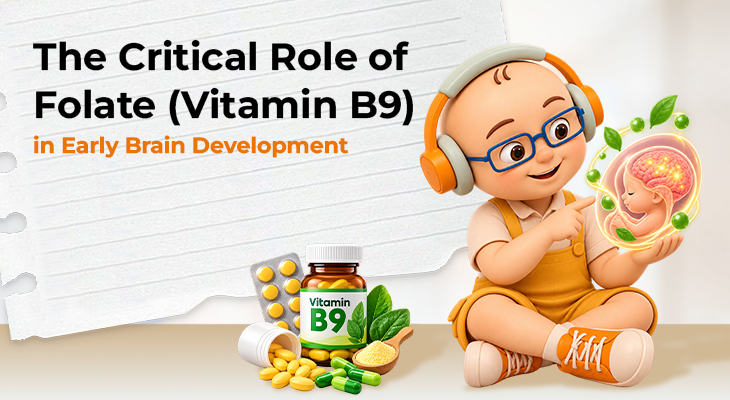


When it comes to essential nutrients that often fly under the radar, vitamin B9—better known as folate—deserves a spotlight. This water-soluble B vitamin plays a starring role in DNA synthesis, cell division, and red blood cell formation, making it vital during periods of rapid growth like pregnancy, infancy, and adolescence. For expectant mothers, adequate folate intake is especially vital, as it helps prevent neural tube defects in the developing fetus. But its importance doesn’t end there: folate also supports brain health, aids in breaking down homocysteine (a compound linked to heart disease), and may even help reduce the risk of certain cancers.
This is a vitamin that your body cannot do without! Let’s take a closer look at all its critical features and functions.
Biochemistry and Metabolic Functions
Folate (vitamin B9) is a water-soluble vitamin that humans cannot synthesize de novo and must obtain from dietary sources or supplements. Chemically, folates are pteroylglutamates that exist in multiple forms, including dihydrofolate, tetrahydrofolate (THF), and 5-methyltetrahydrofolate (5-MTHF). The synthetic form used in supplements and food fortification is folic acid, which has approximately 70% higher bioavailability than naturally occurring food folates.
Folate’s central biochemical role is as a coenzyme in one-carbon (C1) transfer reactions, which are essential for three major metabolic pathways:
1. Nucleotide biosynthesis: Folate cofactors donate formyl groups for the insertion of C-2 and C-8 into the purine ring, and a methylene group for the conversion of deoxyuridylate (dUMP) to thymidylate (dTMP) — the critical step converting the uracil base in RNA to the thymine base in DNA. This makes folate indispensable for DNA replication and repair.
2. Methylation cycle: 5-MTHF serves as the methyl donor for the remethylation of homocysteine to methionine, which is then activated to S-adenosylmethionine (SAM) — the universal methyl donor for dozens of methyltransferase reactions including DNA methylation, histone methylation, and neurotransmitter synthesis. This is critically important.
3. Amino acid metabolism: Folate participates in the interconversion of serine and glycine, and in the catabolism of histidine, as well as in the biosynthesis of neurotransmitters and phospholipids.
Epigenetic Regulation
Folate plays a pivotal role in epigenetic programming through its regulation of DNA and histone methylation. SAM, the end product of the folate-dependent methylation cycle, provides methyl groups for cytosine methylation at CpG sites — a key mechanism for gene expression regulation. Folate deficiency leads to global DNA hypomethylation, genomic instability, and aberrant gene expression, including dysregulation of microRNAs (miRNAs). These epigenetic disruptions are particularly consequential during embryogenesis and early development and may also contribute to cancer initiation and progression.
Hematologic Health: Megaloblastic Anemia
The most classic clinical manifestation of folate deficiency is megaloblastic anemia, characterized by abnormally large, immature red blood cell precursors (megaloblasts) in the bone marrow and macrocytosis in peripheral blood. The mechanism involves impaired de novo synthesis of both thymidylate and purines, leading to defective DNA synthesis, S-phase cell cycle arrest, and excessive apoptosis of erythroid progenitor cells. The FDA-approved indication for folic acid is the treatment of megaloblastic anemias due to folic acid deficiency, with maintenance doses of 0.4 mg daily for adults and 0.8 mg daily for pregnant and lactating women.
Neural Tube Defects and Pregnancy
Perhaps the most impactful public health application of folate is in the prevention of neural tube defects (NTDs), including spina bifida, anencephaly, and encephalocele. Controlled studies have demonstrated that periconceptional folic acid supplementation reduces the risk of NTDs by approximately 69%. It is estimated that up to 70% of NTDs are preventable by increasing folic acid intake during the periconceptional period.
The US Preventive Services Task Force (USPSTF) gives an “A” recommendation — its highest grade — that all persons planning to or who could become pregnant take a daily supplement containing 0.4 to 0.8 mg (400–800 μg) of folic acid. The WHO similarly recommends 400 μg daily from the time of attempting conception through 12 weeks of gestation. Higher doses (typically 4 mg/day) are recommended for women with a prior NTD-affected pregnancy.
Beyond NTDs, inadequate folate status during pregnancy has been associated with increased risk of low birth weight, congenital heart defects, orofacial clefts, placental abruption, spontaneous abortion, preterm delivery, small for gestational age, and stillbirth. Multivitamin supplementation including folic acid has also been associated with lower risks of preeclampsia and certain childhood cancers.
Cardiovascular Disease and Stroke
Folate deficiency leads to elevated plasma homocysteine (hyperhomocysteinemia), which is an established independent risk factor for cardiovascular disease, including coronary artery disease and stroke. The large China Stroke Primary Prevention Trial (CSPPT) demonstrated that folic acid supplementation at 0.8 mg/day reduced ischemic stroke risk by 24% and total CVD risk by 22% in hypertensive adults in a non-fortified population. Meta-analyses incorporating the CSPPT showed a 30% reduction in stroke with folic acid supplementation. However, the applicability of these findings to populations with mandatory folic acid fortification (e.g., the United States and Canada) remains uncertain, as baseline folate levels are substantially higher in these settings.
Neuropsychiatric and Cognitive Health
Folate deficiency and associated hyperhomocysteinemia have been linked to a range of neuropsychiatric conditions:
- Dementia and Alzheimer’s disease: The prospective Framingham study found that high plasma homocysteine doubled the risk of developing Alzheimer’s disease or other dementias. Low serum folate is an independent predictor of dementia and Alzheimer’s disease, and higher homocysteine is associated with more rapid medial temporal lobe atrophy.
- Depression: Multiple community and cross-sectional studies have identified folate deficiency and hyperhomocysteinemia as risk factors for depression.
- Other psychiatric disorders: Folate deficiency has been associated with schizophrenia, organic psychosis, and cognitive dysfunction.
- Neuropathy: Interruption of the methylation cycle — whether from folate or vitamin B12 deficiency — can cause neuropathy, reflecting the critical role of methylation in nerve cell function.
Food Fortification: A Public Health Triumph
Mandatory folic acid fortification of grain products, implemented in the United States since 1998 and now in over 80 countries, is considered one of the most successful public health interventions in history. A 2026 systematic review and meta-analysis found that mandatory grain fortification:
- Increased serum/plasma folate by a mean of 15.0 nmol/L and RBC folate by 329.4 nmol/L
- Reduced the prevalence of serum/plasma folate deficiency by 92% and insufficiency by 83%
Fortification has produced significant reductions in NTD prevalence in the US, Canada, Chile, Costa Rica, Australia, and South Africa. Cost-effectiveness analyses show annual net healthcare savings of $603 million in the US from prevented spina bifida cases alone. Dietary sources of natural folate include legumes, leafy green vegetables, and citrus fruits, though average dietary intake from unfortified foods (~200 μg/day) is typically insufficient to meet optimal requirements.
Summary
Folate is a cornerstone micronutrient whose functions span from the most fundamental molecular processes — DNA synthesis, repair, and methylation — to broad clinical outcomes including prevention of birth defects, anemia, cardiovascular disease, cancer, and neurodegeneration. The evidence supporting periconceptional folic acid supplementation for NTD prevention is among the strongest in all of preventive medicine, and mandatory food fortification programs represent a landmark achievement in public health nutrition.
References
- Folate action in nervous system development and disease.
Developmental Neurobiology. 2018. Balashova OA, Visina O, Borodinsky LN. - Fortification of Wheat and Maize Flour With Folic Acid for Population Health Outcomes.
The Cochrane Database of Systematic Reviews. 2019. Centeno Tablante E, Pachón H, Guetterman HM, Finkelstein JL. - Folate and Vitamin B12.
The Proceedings of the Nutrition Society. 1999. Scott JM. - One-Carbon Metabolism and Epigenetics.
Molecular Aspects of Medicine. 2017. Friso S, Udali S, De Santis D, Choi SW. - Perspectives on Folate With Special Reference to Epigenetics and Neural Tube Defects.
Reproductive Toxicology. 2024. Gurugubelli KR, Ballambattu VB. - Folic Acid Supplementation to Prevent Neural Tube Defects: US Preventive Services Task Force Reaffirmation Recommendation Statement.
The Journal of the American Medical Association. 2023. US Preventive Services Task Force, Barry MJ, Nicholson WK, et al.Guideline - Folates and Prevention of Disease.
Public Health Nutrition. 2001. Molloy AM, Scott JM.