
Table of Contents
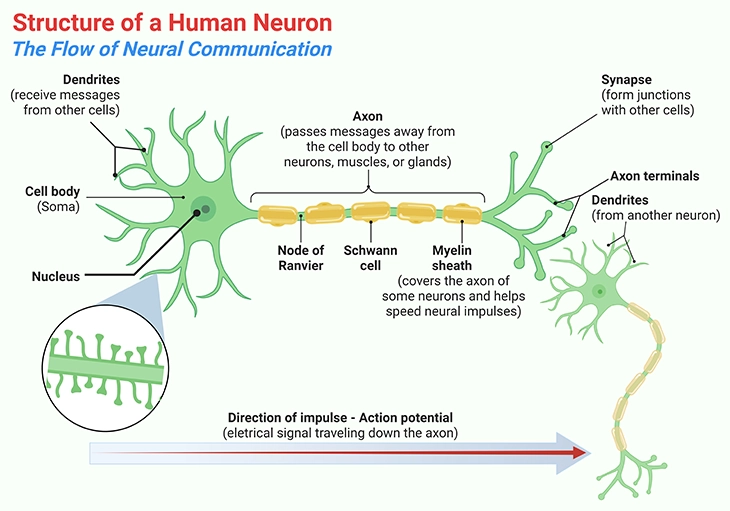
Figure 1. Structure of a Human Neuron and the Flow of Neural Communication. A human neuron gathers thousands of synaptic signals across the delicate constellation of dendritic spines that branch along its arbor. These inputs arrive as synaptic potentials, drifting toward the cell body (soma) like small electrical whispers, where they are woven together at the axon initial segment — the neuron’s decisive threshold point. When this integrated activity reaches the required level, an action potential is generated and travels down the axon in a rapid, selfpropagating wave. At the axon terminals, this electrical impulse is transformed into chemistry, triggering neurotransmitter release that carries the message forward to postsynaptic partner neurons. In this seamless choreography of reception, integration, and transmission, the neuron becomes both storyteller and conduit, shaping the flow of information that underlies thought, perception, and behavior. [Inset: dendritic spines at higher magnification]
Introduction
The Adolescent Brain: A Symphony Still Composing Itself
Adolescence is often described as a storm, a season of unruly impulses and unpredictable moods, but beneath the surface lies something far more intricate and astonishing. The teenage brain is not a chaotic organ waiting to “settle down”; it is a symphony in active composition, its circuits tuning, pruning, and strengthening in response to the world and to the adolescent’s own emerging sense of self. This period marks the most dramatic reshaping of neural architecture since early childhood, a time when the brain is both exquisitely vulnerable and profoundly capable of transformation.
At the heart of this metamorphosis are the frontal lobes, regions that support planning, foresight, flexible thinking, and the delicate art of social understanding. Here, neurons behave like restless artists, extending and retracting dendritic spines at breathtaking speed—sometimes turning over a quarter of their synaptic connections in a single week. These changes are not random flourishes. They reflect a brain testing possibilities, evaluating outcomes, and stabilizing the circuits that prove meaningful. By the midtwenties, this rapid turnover slows to 10% or less, signaling the gradual closing of a developmental window in which experience can leave deep, structural marks [1-4].
What makes this period even more remarkable is that the adolescent brain is not merely shaped by the world; it is shaped by its own actions. Each attempt, each strategy, each misstep and triumph becomes a sculpting force. The brain asks, “What did I try?” and “What did that mean for me?”—a form of self-referential learning that weaves together identity, motivation, and emerging behavioral style. In this sense, adolescence is not simply lived; it is constructed, neuron by neuron.
These insights carry particular weight when we consider autism during adolescence, a developmental stage that often brings new challenges and new strengths. Research suggests that synaptic pruning may follow distinct trajectories in autistic individuals, with differences in spine density, microglial refinement, and frontal cortical connectivity shaping how learning, social reasoning, and sensory experience unfold. For some autistic adolescents, heightened sensitivity to environmental input or reliance on repetitive, self-generated strategies may reflect not deficits but alternative pathways of plasticity. The shifts in executive function, social motivation, or sensory processing that often emerge during these years are not signs of regression; they are signatures of a brain undergoing massive reorganization, guided by both biology and experience [5-7].
To understand adolescence—neurotypical or autistic—is to recognize it as a time limited window of transformative plasticity, a moment when the brain is unusually open to being shaped. Experiences during these years are not trivial; they are sculptors, stabilizing some circuits while allowing others to fade. Supportive relationships, enriched environments, structured challenges, and opportunities for autonomy can help guide this neural symphony toward resilience and flourishing. For autistic adolescents, this understanding invites more compassionate expectations and more tailored supports, aligned with the brain’s natural rhythms of change.
Adolescence, then, is not a problem to be endured but a rare developmental opportunity—a fleeting moment when the brain is still composing itself, still listening for the melodies that will carry into adulthood. And in this delicate interplay of biology and experience lies the possibility of shaping a mind for life.
I. The Adolescent Brain: A Landscape Still Under Construction
A Brain in Motion, Not in Mayhem
Your twelve-year-old is not only growing taller and sprouting new hair — they are also reshaping the architecture of their brain. The phrase “the teenage brain” often triggers a knowing smile, as if everyone suddenly becomes an expert: wild, irrational, hormonesoaked, frontal lobes offline. But these popculture caricatures risk obscuring what is actually unfolding inside the adolescent mind. When we look closely — truly closely — at what their neurons are doing, the story becomes far more nuanced, far more creative, and far more biologically elegant.
What Brain Scans Reveal
Neuroimaging shows that adolescent brains differ meaningfully from both children and adults. During the teenage years, gray matter gradually thins while white matter expands, reflecting ongoing refinement of neural circuits. It often takes until the mid twenties for brain scans to resemble the adult pattern, with the frontal lobes — the region supporting selfcontrol, planning, and anticipating consequences — maturing last. This delayed maturation is frequently invoked to explain teenage risktaking, from screen use to substance exposure to sexual behavior, and is often used to justify restricting adolescents’ access to activities deemed “dangerous” or “adult.”
Beyond the Stereotypes
It is tempting to interpret this developmental period as a temporary lapse in sanity — a biological storm that renders teenagers impulsive or “out of control.” Yet a deeper look reveals something far more inspiring. There is no void where the frontal lobes should be, no neural blackout. Instead, adolescent neurons are highly active, highly adaptive, and engaged in a kind of creative reorganization that prepares the brain for adult life.
A New Window Into the Living Brain
Over the past two decades, advances in imaging — especially in vivo twophoton laser scanning microscopy — have allowed scientists to observe individual neurons in living animals as they grow, retract, and reconfigure. Before the early 2000s, we relied on static snapshots from postmortem tissue. Now, we can watch neurons before and after new experiences, capturing hours of developmental “footage” instead of a single frozen frame. This shift is as dramatic as moving from a single black-and-white photograph to a full childhood video archive.
Exploration as a Neural Imperative
These technologies reveal that juvenile and adolescent frontal lobe neurons are explorers. They extend and retract dendritic spines, test potential synaptic partners, and sample the informational landscape of the brain. Their mission is not chaos — it is connection seeking, pattern testing, and experience driven refinement. Adolescence is not a period of neural dysfunction; it is a period of neural possibility, where circuits are sculpted by exploration, learning, and the demands of an increasingly complex world [1-4].
II. The Restless Architecture of the Adolescent Brain
Neurons as Living Topiaries
Neurons in the developing brain resemble craggy, twisting trees, their branches and roots woven into a dense biological forest long before puberty begins. By late childhood, these neurons have already reached their full “height,” yet their dendritic branches remain in constant motion, adjusting their shape and connectivity. In laboratory animals such as mice, researchers can illuminate a single neuron within this thicket and capture images or videos as it matures. What emerges from these observations is a dynamic landscape of change centered on tiny, thornlike protrusions called dendritic spines (see Figure 1 – Inset).
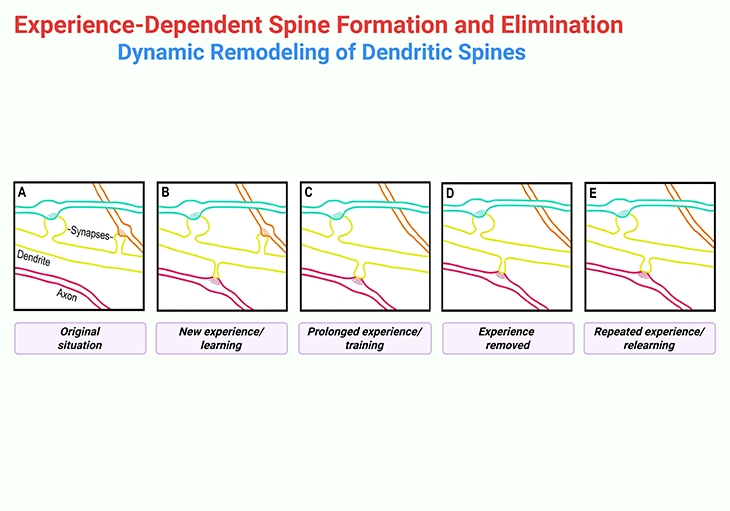
Figure 2. Experience-Dependent Spine Formation and Elimination. This figure depicts the dynamic remodeling of dendritic spines—the tiny postsynaptic structures that host the brain’s excitatory synapses—as they are formed, stabilized, or eliminated in response to experience. During adolescence, neurons in the frontal cortex show exceptionally high rates of spine turnover, with new spines emerging during learning, exploration, and self-generated action, while others retract when they are no longer supported by meaningful activity. This selective stabilization and pruning of excitatory synapses is a core mechanism of experience-dependent plasticity, enabling the adolescent brain to refine its circuits and consolidate adaptive patterns of thought and behavior. Altered trajectories of spine formation or elimination, as reported in autism, may shift the timing or efficiency of this remodeling, contributing to the distinct developmental pathways observed during autistic adolescence. Together, these processes highlight how experience sculpts the excitatory architecture of the brain during a sensitive window of neural becoming.
A Forest in Flux
From postmortem studies, we have long known that dendritic spines become less numerous as humans and common laboratory animals transition into early adulthood. But watching neurons alive reveals a far more dramatic story: these spines are not simply disappearing — they are sprouting, extending, retracting, and probing the outputs of neighboring neurons. A synapse forms when a spine stabilizes and connects to another neuron’s arbor; that same connection dissolves when the spine withdraws back into its parent dendrite (see Figure 2; Figure 3).
Repeated imaging over days shows neurons growing new spines and losing most of them again shortly afterward. This continual cycle of growth and retraction appears to be a form of connectivity exploration, a biological trial run of potential partners. As puberty approaches, neurons may gain and lose 25% or more of their connections each week. By young adulthood, this turnover slows to 10% or less, depending on the brain region. Because a neuron’s connectivity defines its role in the network, its functional identity can shift dramatically from week to week during development — a level of change so profound that, metaphorically, a person could be “25% different” from one week to the next.
As adulthood approaches, the overall number of connections declines, and the capacity for forming new ones diminishes, marking a gradual transition from exploration to consolidation.
Why This Matters for the Teenage Frontal Lobes
This highvolume turnover of synaptic connections may help explain why the frontal lobes — responsible for planning, impulse control, and flexible thinking — operate differently in adolescents than in adults. Reduced efficiency may be one consequence of this neural flux. Yet the same instability may also confer greater learning capacity, heightened adaptability, and a remarkable ability to reorganize in response to new demands. These rapidly shifting networks form the substrate of emerging adult personality, shaping tendencies, preferences, and patterns of thought. In essence, the adolescent brain is a neural topiary, sculpted into individuality by forces both internal and external.
Experience as the Master Gardener
This brings us to the central question: What shapes this neural topiary? The answer, increasingly clear from modern neuroscience, is experience. At any given moment, countless synapses in the developing brain exist in a fragile, provisional state. Which ones survive depends on trial-and-error learning driven by active engagement with the world (see Figure 2; Figure 3) [1-4].
Studies tracking gains and losses of dendritic spines show that when a new skill or rule is learned, an entire cohort of newly formed connections is stabilized. In motor cortex, for example, learning a new movement pattern preserves a fresh crop of spines. In the frontal lobes, new connections are retained when the brain learns that two events reliably cooccur — such as a sound, sight, or smell paired with something rewarding or aversive.
Experience, therefore, is not merely influencing the adolescent brain — it is selecting, strengthening, and sculpting the very circuits that will define the adult mind.
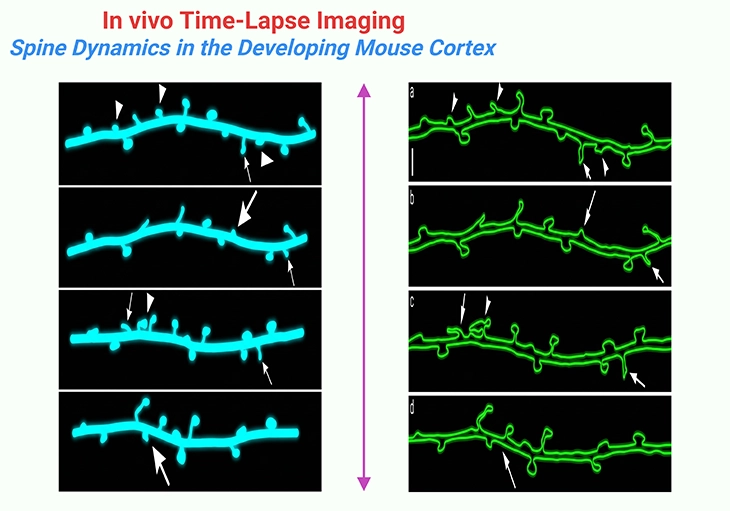
Figure 3. In vivo TimeLapse Imaging of Spine Dynamics in the Developing Mouse Cortex. Across 4 to 6 weeks of age, repeated in vivo imaging of individual dendritic branches reveals the restless choreography of structural plasticity in the mouse cortex. Spines marked for elimination (arrowheads), newly formed spines (large arrows), and transient filopodia (small arrows) appear and disappear over time, capturing the continual reshaping of the neuron’s excitatory landscape. These dynamic events unfold in both the control cortex (a, b) and the sensory-deprived barrel cortex (c, d), illustrating how experience — or its absence — sculpts the evolving architecture of synaptic connectivity during early postnatal development.
III. How Experience Shapes the Adolescent Neural Topiary
Neurons That Track the World — and the Self
Recent experiments reveal that neurons in the developing frontal lobe are not merely cataloging what happens in the external world — whether an event was rewarding or punishing — but are also tracking self-generated actions. The growth and pruning of synaptic connections appear to encode questions such as: “What strategy did I just try?” and “Was that good or bad for me?” This means that self-initiated trial error behavior, not just passive observation, plays a formative role in shaping the adolescent brain’s evolving circuitry. In other words, the frontal neural topiary is sculpted differently when a teenager acts, compared to when they merely watch.
Why This Matters More Than It Seems
If gardening metaphors, neural topiaries, or teenagers themselves feel distant, you might wonder whether any of this matters. One might shrug and say: “So what? This has been happening in mammalian frontal lobes for millions of years. Teenagers are still immature.” But seeing neurons sprouting, reaching, connecting, and retracting — undergoing their own developmental adolescence — fundamentally reframes the story (see Figure 2; Figure 3).
Two Opposing Interpretations of the Teenage Brain
If we imagine teenagers as akin to patients with frontal lobe damage, we might conclude they need protection from themselves and from the world. We might keep them sheltered, waiting for maturity to arrive on its own.
But if we instead imagine the frontal lobes as populated by neurons hungrily grasping for information, racing to form the connections that will define adult identity — and if we recognize that this capacity for change is waning by the day — then the conclusion flips. We might feel compelled to push teenagers outward, into the world of real challenges, real consequences, and real learning. Perhaps not literally to an Arctic wilderness camp — but the metaphor stands.
The High Stakes of Adolescent Experience
These extremes illustrate a deeper truth: the fate of countless new synapses makes adolescence a period of serious developmental opportunity, not frivolity. Warehousing teenagers in overstressed schools, refugee camps, or environments devoid of stimulation becomes, in this light, a tragic waste — one from which a generation may never fully recover.
This science suggests that pretend play is not trivial; it is a precursor to adult work. It suggests that some painful stumbles — emotional or physical — may be essential for growth. And while centuries of wisdom about protecting teenagers still hold (we should not grant them unrestricted access to drugs, or endless videogame immersion), we must also recognize that their neurons are alive, exploring, and taking shape from every experience.
Experience as Destiny
These experiences, in turn, are likely to shape the adult mind — its habits, its emotional contours, its strengths, and its vulnerabilities. The adolescent brain is not simply immature; it is becoming. And what it becomes depends profoundly on what it encounters.
Take-Home Messages
- Adolescent neurons are not chaotic — they are exploratory, actively testing and refining potential connections that will shape adult cognition and behavior.
- The frontal lobes track both the external world and the self, encoding not only what happened but what the teenager tried and how it turned out for them.
- Self-generated trial error experiences sculpt frontal lobe circuits more powerfully than passive observation, reinforcing the importance of active engagement.
- During adolescence, synaptic connections undergo rapid turnover — often 25% per week — making this a period of extraordinary neural possibility and vulnerability.
- As adulthood approaches, synaptic plasticity declines, narrowing the window for large-scale structural change and making early experiences disproportionately influential.
- Viewing teenagers as “immature” misses the deeper truth: their brains are actively constructing identity, not merely waiting to become adultlike.
- Enriched, challenging, and meaningful experiences stabilize new synapses, while deprivation or monotony risks losing developmental opportunities that may not return.
- The adolescent brain’s capacity for change is timelimited, making supportive guidance, structured exploration, and realworld learning essential.
- Protecting teenagers is important — but oversheltering them wastes a critical developmental window, while thoughtful exposure to challenge strengthens neural architecture.
- Ultimately, experience is the master sculptor: the patterns of action, emotion, and learning in adolescence leave enduring marks on the adult mind.
(Cf. previous blogs entitled as: “When the Brain Builds Itself.”; “Before the Pathway Sets: How Early Experience Shapes the Developing Autistic Brain.”)
Summary and Conclusions
Adolescence is a fleeting season when the brain behaves like a living poem — restless, searching, pruning, and reaching toward its future form. Beneath the visible transformations of teenage life, the neural landscape is undergoing a profound metamorphosis. The frontal lobes, still maturing well into the midtwenties, orchestrate this transformation through waves of synaptic growth and loss, sometimes replacing a quarter of their dendritic spines within a single week. These changes are not random fluctuations but the biological choreography of a brain testing possibilities, evaluating outcomes, and stabilizing the circuits that will carry an individual into adulthood. By young adulthood, this turnover slows to 10% or less, signaling the gradual narrowing of a window in which experience can leave deep structural marks.
What makes this period extraordinary is that the adolescent brain is shaped not only by the world it encounters but also by the actions it generates. Recent findings reveal that frontal lobe circuits track not just external events but the adolescent’s own strategies — what they tried, why they tried it, and how it turned out for them. This self-referential learning, grounded in trial and error, becomes a sculpting force that weaves together emerging identity, motivation, and behavioral style. Experience is not merely absorbed; it is translated into structure, stabilizing some synapses while allowing others to fade.
These insights resonate deeply with our understanding of autism during adolescence, a developmental stage marked by both heightened vulnerability and remarkable potential. A growing body of evidence suggests that synaptic pruning may follow distinct trajectories in autistic individuals, with reports of altered spine density, reduced pruning efficiency, and differences in microglia-mediated synaptic refinement. Functional and structural connectivity within prefrontal networks often develops along unique timelines, and experience-dependent plasticity may operate differently, sometimes amplifying sensitivity to environmental input or reinforcing repetitive, self-generated learning patterns. The shifts in executive functioning, sensory processing, social motivation, or adaptive behavior that often emerge during adolescence are not signs of regression but reflections of a brain undergoing massive reorganization — a brain whose developmental rhythms may differ, but whose capacity for change remains profound [5-7].
Yet despite these advances, much remains unknown. We still lack a complete understanding of how genetic factors, neuroimmune signaling, hormonal cascades, and environmental exposures converge to shape synaptic pruning during adolescence. The precise mechanisms through which self-generated behavior influences frontal lobe circuitry are only beginning to be mapped. And the heterogeneity within the autism spectrum — spanning differences in learning profiles, sensory reactivity, and social cognition — suggests that multiple developmental pathways may exist, each shaped by distinct patterns of plasticity. Longitudinal studies that follow synaptic dynamics, microglial activity, and connectivity patterns from childhood into adulthood are essential to illuminate these trajectories.
Looking forward, the science points toward a future in which interventions are aligned with the brain’s natural windows of plasticity. Enriched environments, structured challenges, guided autonomy, and supportive relationships may help stabilize adaptive circuits during adolescence, particularly for autistic youth. Advances in in vivo imaging, computational modeling, and single cell transcriptomics promise to deepen our understanding of how experience sculpts the adolescent brain at cellular and network levels. Ultimately, recognizing adolescence as a period of time limited, experience sensitive neural transformation reframes how we support young people. It invites us to see beyond stereotypes of immaturity and instead recognize a brain actively composing itself — one that requires guidance, opportunity, and compassion to reach its fullest potential.
In this delicate interplay of biology and experience lies the enduring truth: adolescence is not merely a passage but a creative act of becoming, a moment when the brain writes the opening lines of the adult mind it will one day become.
Did You Know? Folate Receptor Autoantibodies (FRAAs) may impede proper folate transport.
Folate (vitamin B9) is very important for your child’s brain development!
During pregnancy, it helps prevent neural tube defects and plays a big role in forming a normal and healthy baby’s brain and spinal cord. Folate also helps cells divide and assists in both DNA and RNA synthesis.
Emerging research suggests that the presence of FRAAs negatively impacts folate transport into the brain.
- Recent studies reveal that a large subgroup of children with autism spectrum disorder (ASD) have FRAAs.
- This suggests that a possible disruption in folate transport across the blood-cerebrospinal fluid (CSF) barrier may potentially influence ASD-linked brain development.
- Screening for the FRAAs in your child should be part of your early intervention strategies.
Is there a test for identifying Folate Receptor Autoantibodies (FRAAs)?
Yes, there is a test – The Folate Receptor Antibody Test (FRAT®) has emerged as a diagnostic tool for detecting the presence of FRAAs.
It is important to screen at an early age or as soon as possible as there may be corrective measures available. Please consult your physician for further information.
To request a test kit, click on the button below.

For information on autism monitoring, screening and testing please read our blog.
References
- Petanjek Z, Judaš M, Šimic G, Rasin MR, Uylings HB, Rakic P, Kostovic I. Extraordinary neoteny of synaptic spines in the human prefrontal cortex. Proc Natl Acad Sci U S A. 2011 Aug 9;108(32):13281-6. doi: 10.1073/pnas.1105108108. Epub 2011 Jul 25. PMID: 21788513; PMCID: PMC3156171.
https://pubmed.ncbi.nlm.nih.gov/21788513/
(Demonstrates prolonged dendritic spine pruning in the human prefrontal cortex into the third decade of life, anchoring your argument about extended adolescent plasticity.) - Holtmaat A, Wilbrecht L, Knott GW, Welker E, Svoboda K. Experience-dependent and cell-type-specific spine growth in the neocortex. Nature. 2006 Jun 22;441(7096):979-83. doi: 10.1038/nature04783. PMID: 16791195.
https://pubmed.ncbi.nlm.nih.gov/16791195/
(Demonstrates that sensory experience drives selective growth and stabilization of dendritic spines in the neocortex, revealing how experience-dependent structural plasticity shapes cortical circuits at the level of individual synapses.) - Huttenlocher PR. Synaptic density in human frontal cortex – developmental changes and effects of aging. Brain Res. 1979 Mar 16;163(2):195-205. doi: 10.1016/0006-8993(79)90349-4. PMID: 427544.
https://pubmed.ncbi.nlm.nih.gov/427544/
(Foundational evidence for synaptic overproduction and pruning in the frontal cortex, establishing the developmental timeline your article builds upon.) - Konrad K, Firk C, Uhlhaas PJ: Brain development during adolescence: neuroscientific insights into this developmental period. Dtsch Arztebl Int 2013; 110(25): 425–31. DOI: 10.3238/arztebl.2013.0425.
https://api.aerzteblatt.de/pdf/DI/110/25/m425.pdf
(Defines adolescence as a period of network reorganization, vulnerability, and opportunity — directly supporting your framing of adolescence as a window of transformation.) - Tang G, Gudsnuk K, Kuo SH, Cotrina ML, Rosoklija G, Sosunov A, Sonders MS, Kanter E, Castagna C, Yamamoto A, Yue Z, Arancio O, Peterson BS, Champagne F, Dwork AJ, Goldman J, Sulzer D. Loss of mTOR-dependent macroautophagy causes autistic-like synaptic pruning deficits. Neuron. 2014 Sep 3;83(5):1131-43. doi: 10.1016/j.neuron.2014.07.040. Epub 2014 Aug 21. Erratum in: Neuron. 2014 Sep 17;83(6):1482. PMID: 25155956; PMCID: PMC4159743.
https://pubmed.ncbi.nlm.nih.gov/25155956/
(Landmark mechanistic study linking impaired synaptic pruning (via mTORautophagy pathways) to autismlike phenotypes, grounding your autism-specific claims.) - Zoghbi HY, Bear MF. Synaptic dysfunction in neurodevelopmental disorders associated with autism and intellectual disabilities. Cold Spring Harb Perspect Biol. 2012 Mar 1;4(3):a009886. doi: 10.1101/cshperspect.a009886. PMID: 22258914; PMCID: PMC3282414.
https://pubmed.ncbi.nlm.nih.gov/22258914/
https://cshperspectives.cshlp.org/content/4/3/a009886.full.pdf+html
(Highimpact review connecting synaptic dysfunction and plasticity mechanisms to neurodevelopmental disorders, including autism, reinforcing your core conceptual framework.) - Berger JM, Rohn TT, Oxford JT. Autism as the Early Closure of a Neuroplastic Critical Period Normally Seen in Adolescence. Biol Syst Open Access. 2013 Aug 20;1:10.4172/2329-6577.1000118. doi: 10.4172/2329-6577.1000118. PMID: 24353985; PMCID: PMC3864123.
https://pubmed.ncbi.nlm.nih.gov/24353985/
https://pmc.ncbi.nlm.nih.gov/articles/PMC3864123/pdf/nihms521973.pdf
(Proposes autism as involving altered timing of critical periods, aligning perfectly with your theme of adolescence as a sensitive window of neural becoming.)